Monday, 26 April 2021

Locomotives of the Liverpool & Manchester Railway

Locomotives of the Liverpool & Manchester Railway by Anthony Dawson covers a fascinating time in railway, engineering, and indeed social history - the development of the steam engine from a primitive and unreliable industrial machine to a means of reliable and convenient transport. The Liverpool & Manchester Railway was of course the first public and passenger carrying steam railway - the railways that existed at that time carried only freight (usually coal or minerals), and very few (including the Stockton & Darlington) used steam locomotives. 


The story of the Rocket winning the Rainhill Trials is famous enough to have featured on a £5 note, and the father and son team behind it George and Robert Stephenson are well known for developing the steam locomotive into a practical reality. This book starts in the run up to the Rainhill trials which were actually about whether steam locomotives should be used at all, rather than to select a winning design. Strangely the book doesn't describe the trials, but continues with the development from Rocket to the engines used when the lined opened (incorporating several significant advances), and then through the early years of the railway as knowledge of steam engines increased with each new design. While the Stephensons had much influence initially, they were resisted by some and alternative designs were tried - generally it must be said with little success, although within a few years it was those running the locomotives in daily use who gained the experience to improve the designs. 


As an engineer I found the development story fascinating - the early locomotives had no effective means of controlling steam into the cylinders, no balance weights to counter the massive forces of moving motion, poor firebox designs and no smokebox, not even any brakes. The engineering ideas had run ahead of materials science, and fireboxes, boiler tubes, and cranked axles failed regularly - as did the track. The early locos had shockingly short lives - 2 to 3 years in some cases - before wearing out or becoming obsolete due to advances in technology. The familiar outline and key features of steam locomotives appeared in those first few years, rather like the development of horseless carriages into motor cars about 60 years later, in fact the advances in technology at that time can be compared to the development of the mobile phone, rise of the internet, or transition from G-Wizz to Tesla in more recent times - arguably with a greater impact on mankind. 

The book goes on to discuss the early enginemen and foremen responsible for operating the locos, their maintenance and repair, and the passenger and goods stock - this is interesting as like the locomotives there was no existing template, and early designs had their flaws. However, there were some strange omissions from the book as in many ways it fails to set the context. There is no background to the Liverpool & Manchester railway - why it came about, the key events in its history, even its geography (which has relevance to the locomotives) - nor the parallel developments in the railway world at that time. As noted above even the Rainhill trails are glossed over. I notice that the same author has written an operating history of the Liverpool and Manchester by the same publisher (which also looks interesting) and perhaps that fills some of these gaps, but properly setting the scene in brief here would help understand the subject of this book better, and could have been done in a short prologue, or even an appendix. 

Also, some of the technological developments were not well explained, such as the advantage of a blast pipe, or how a good firebox and boiler work so as to understand the primitive versions then being developed. One diagram shows Buddicom's valve gear with the comment "from which the Stephenson-Howe link valve gear was an obvious evolution" - except that without an explanation of Stephenson-Howe link valve gear it is not obvious at all. As an engineer and railway enthusiast I generally had little difficulty in understanding the technologies described, but if it wasn't always clear to me it then won't be to all readers. Given the object of the book is to "chart the development" of these locomotives a few extra words or diagrams to explain some of these ideas would help many readers. 


That said, there are some excellent illustrations from contemporary drawings (both technical and illustrative) and engravings - of course there were no photographs at that time, although a few of modern replicas are included. The text is well written and easy to read, and is clearly well researched. I found it a fascinating read, and anyone with an interest in steam engines, engineering, or history of the industrial revolution will enjoy it too. 

Tuesday, 20 April 2021

Turning sand into gravel

Obviously the sand surface needs to be painted if it is to look like anything other than sand. These are large areas, and the sand has a large surface area as well as being abrasive. I use cheap acrylic paints and a cheap, stiff paintbrush - the stuff sold for kids is fine for this job. Colours are mixed from white, black, red, green, and yellow - I can't say I find mixing colours easy and I usually end up with something too dark. Also a single colour sometimes looks too flat and plain, the aim is for a finish that is not too even which I attempt with multiple washes. 

The platform got a coat of pale grey, this seems to have come out well and looks fine as well tended gravel so I left it at that. The road and car park behind got a darker coat which looked too even, so it was followed by a much thinner coat of mid brown to weather it and add shadows. However, this looked too dark, so another thinned coat of pale grey was added. The result is a mid grey that isn't too even as the thinner coats have had differing effects at different depths. 


The yard at the front had a browner shade of grey to represent a gravel, followed by a very thin mid brown wash to add depth. Again, this ended up looking too dark, so I experimented. I dabbed talcum powder over the surface with a sponge, and then vacuumed it off while working it with a stiff paintbrush. The result has worked surprisingly well, giving a pale dusty gravel look which is patchy and varied in colour. 


While the paints were out the mid brown was further diluted with added Isopropyl Alcohol (IPA) - giving a very runny wash. This was applied over all the track ballast, though perhaps more in some areas than others, which adds a slightly brown weathered look to the granite and because it collects in the gaps, adds some depth to the colour. 


So there are three areas with three different finishes from the same basic materials - sand and paint. The front yard is dusty gravel, the platforms a neat even gravel, and the rear roadway and yard a rough tarmac. I've tried to blend them to the surrounding areas such as the public road and the ballast. 

Right at the top of the station access road near the phone box the last coat of paint covered some talc overspill, which has accidentally given a very pleasing mottled look, I might use that technique on purpose in the future. 


I'd also used a little sand to make pathways across and alongside the ballast, which were given similar paint treatment to represent a grey gravel. The walkways aren't really necessary, but gravel is easier to walk on than ballast and probably cheaper too, while I'm also using it to disguise the uncoupling magnet!


Monday, 19 April 2021

Bases and surfacing

The yard at Hexworthy will be used as a "permanent way" (track) maintenance yard, and will have a grounded shipping container. These are often placed on timbers, so I made up some from plasticard, along with a rudimentary ramp up to the doors, and stuck them down before surfacing the yard.


I also added bases for a phone box - which I thought would add interest and look plausible placed by the road entrance - and the heating oil tank. These were simply made from a little DAS clay. 


At the back of the station building I added a pavement from a layer of thick card, cut to the shape of the building by drawing around it. I was going to just run the tarmac up to the back of the building but this seems neater as it means the building doesn't have to be fixed down (yet), it is a tight fit in, and allows easier access to the narrow space behind. It is made simply to represent concrete, mainly as it won't really be seen so no point in putting in a lot of effort!


All the roadways, platform and yard areas are textured with fine sand. I use play sand as sold for children's play pits, having kept a couple of jars when my kids grew out of theirs, though a large bag is very cheap. It is fine enough to be a good representation of gravel or tarmac. First I put down an even layer of PVA glue, which is slightly diluted (about 3:1 with water), and no need for washing up liquid here. 


I use an old tea strainer which helps scatter the sand evenly and stops any oversize particles. Sand is added a little at a time by tapping a teaspoon onto the strainer. This gives an even finish, but I have found it best to let it dry fully and vacuum off excess before checking, and not be tempted to add more glue/sand as this gives an uneven finish. If necessary a second application can be made later, although this is rarely needed. 


I've used the sand for the yard at the front, the platform surfaces away from the paved area, and the road/yard at the rear. Although they look the same now, they will be given different finishes in painting. 


Sunday, 11 April 2021

Ballasting Hexworthy

Before ballasting I needed to glue down the platform - thus far it has not been in fixed, and was in two pieces, which was convenient for working on. However, the fixing of the slabs had caused a slight curvature to the 3mm foam-core platform pieces, so I needed to be sure it would lie flat. Gentle working between the fingers got the pieces flat before they were stuck in place with PVA. Clearances were double-checked with some larger locos to ensure the position was correct, and the larder raided for some weights to ensure it stayed fully flat while the glue set.


Ballasting isn't most people's favourite job, in fact it is rather tedious, but worth taking a little time as it covers a significant part of most layouts. I use fine granite ballast, I got a big bag many years ago and I'm still working my way through it. 

The area to be most careful is around the moving parts of the points, my approach here is to carefully apply neat PVA around the tie bar area positioning it with a screwdriver tip or something, making sure it is well clear of the tie bar, then add stones. This is left to dry before ballasting around it, the idea is the carefully positioned stones form a protective "dam" around the tie bar area.


Since the baseboard is foam-core board it was easy to cut a drainage ditch between the platform and loop roads. Because of the steep sides I applied neat PVA and stones first here too. 


The process is well established. I apply the ballast from a tea spoon, tapping it to carefully dispense it where needed, I spread it with a finger and a cheap, stiff, flat brush. Tapping the spoon on the rails helps the stones settle and shakes some off the sleepers, but there is still a need to brush off any stones that remain on the sleepers or up against the rail sides. Next is a vital step - the ballast is wetted with a fine mist of water/IPA mixture, water with washing up liquid works too but the IPA seems to work better. This allows the water to soak into the ballast without disturbing it. 


Finally the glue is added, PVA glue diluted about 50:50 with the drop of washing up liquid to reduce the surface tension. I use a plastic dropper and gently drip the glue into the ballast, which shouldn't disturb it and thanks to the prior soaking with water/IPA it is drawn right into the ballast. The tricky bit is seeing which bits have been done, as all the ballast looks wet!


So a slow process I tend to do in small areas at a time, an hour or so in one go is enough. Fortunately this is a small layout, but even so it took four or five sessions. As this will represent a preserved line the ballast needed to be fairly neat, which I've achieved. 


Wednesday, 24 March 2021

Boulders

 A little while back, on the tip-off of a friend, I bought a Woodland Scenics boulders rock mould. It's a flexible rubber mould for casting boulders in plaster. Of course Woodland Scenics recommend their own casting plaster, but I still have some Linka compound left in a large tub - it must be close to 30 years old, but it still works! I expect dental plaster or similar would work too. 


I mixed up a batch without measuring - mainly because I don't know what the mixture should be - and added some acrylic paint to tint it so possible chips do not show white. When the mixture was creamy I filled the mould, which had first been misted with a fine spray of water and washing up liquid.


Amazingly I'd mixed just enough to fill the mould! I bet I couldn't do that again. After an hour or so I eased the mouldings out of the mould.


They do look like boulder rocks with a nice texture. There's a little variety in size and shape but not a lot. It is amazing how much lighter they dried compared to the colour of the mix. 

The idea is to line the river bank, though I'm not quite sure how to use them. Lined up like this looks too regular, I think a few irregularly spaced with some smaller rocks in between is what is needed. I could try casting another batch partially filling the mould? 

I also need small rocks and stones, I've seen others use cat litter but I don't have a cat...

Tuesday, 16 March 2021

Loctern Quay in 009 News

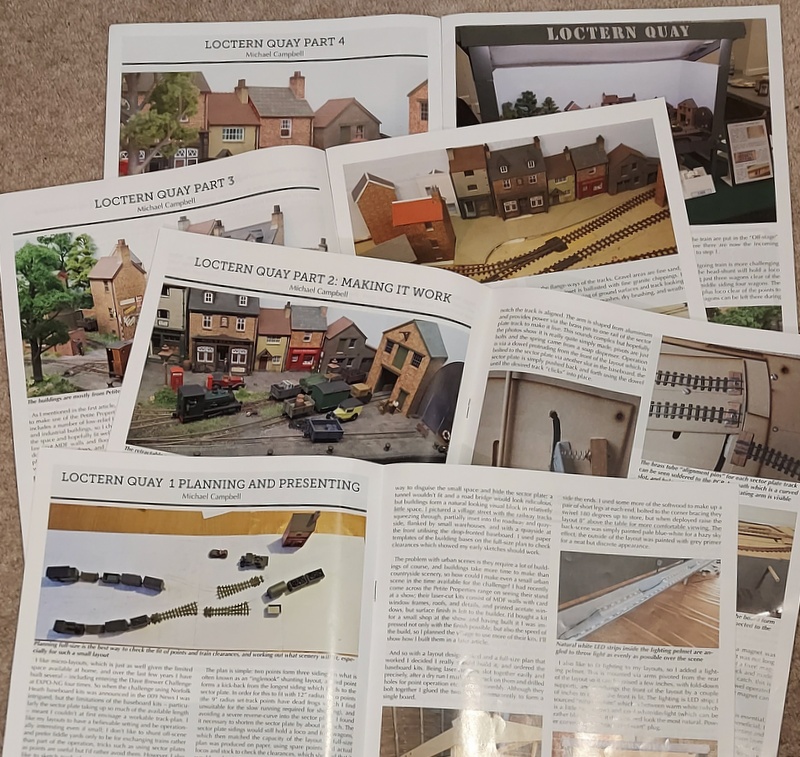
The March issue of the 009 News carried the last article in a 4-part series about Loctern Quay, which even made the cover on the January edition.


The four articles covered the design of the layout including its presentation and lighting; the trackwork, sector plate, and electrics; the buildings and scenery; and finally the stock and operation. Not bad for such a small layout, but it has been nice to cover these topics in detail, and see lots of photos published too. Since this layout was born out of a 009 News challenge it is the appropriate place to tell its story. 


The 009 News is the magazine and newsletter of the 009 Society, if you are interested in 009 and not a member why not join? I have found membership beneficial and rewarding over many years. For the last few years the 009 News has been edited by my friend Chris Ford, but the April issue will be his last as he passes on the proverbial blue pencil to a new editor. Thanks for all the great work Chris!

Tuesday, 9 March 2021

Book: Britain's Railways in the Second World War

Britain's Railways in the Second World War by Michael Foley is a new book from Pen & Sword. Obviously I've an interest in railways, and as an important part of Britain's recent history I take an interest in the World Wars too, so was intrigued by this book. 


It is what it says on the cover, the story of how the railways of Britain reacted, coped, and were used during the war, from evacuating children to feeding the essential manufacturing to moving troops and armour, all while struggling with reduced staff and limited resources. The story is told chronologically, from the start of war through Dunkirk and the Blitz to the support of D-day and beyond, although these events are the background and have an impact on the railways this isn't a military story. There are many human stories, and much about the organisation and running of the railways. 

The text does sometimes jump from one topic to another, and there are some instances of a topic being repeated from another perspective, maybe this is due to the chronological approach but in some places careful editing and rephrasing could have made the text flow better. Strangely, the GWR was referred to as GWS several times throughout the book (so not an isolated typo), even using GWR and GWS in the same paragraph, this and a couple of other minor errors suggest proofing could have been more rigorous.  Overall though, the text is engaging and interesting to read, and avoids complex and technical language making it easy to follow. 


The book is illustrated with photographs, many of them from the period and some with a direct connection to the text, although for a few the relevance is tenuous and probably better subjects could have been chosen. Reproduction is not great, being printed on the standard paper, and all in black and white although some originals would have been colour. Perhaps they would have been better grouped into photographic paper sections, which would allow better definition and possibly colour, although for those linked to the text this would have been less effective. In any case, this book is a story and historical picture, not a photo album, so the use of the photographs is appropriate in adding interest rather than being key. 

There is also a glossary, although it seemed rather short, readers who are not railway enthusiasts or without some familiarity of British railways might have appreciated a more comprehensive glossary.  A nice touch is the short chapter detailing where some locos, stock, and memorials from the time can be found, and noting that preserved railways can give a feel for what wartime railways may have been like. 


I found this an enjoyable book that feels more like a story than a history book to read. It tells of an important aspect of the wartime struggle and what life was like for the railway companies and their workforce. For those with even a passing interest in railways or in the impact of the second world war this is a book worth reading.