Showing posts with label narrow gauge. Show all posts

Thursday, 19 December 2019

Book Review: The Corris Railway - Peter Johnson

This is a new release from Pen and Sword books, "The Corris Railway - The story of a mid-Wales slate Railway" by Peter Johnson, and it is pretty much what it says on the cover.


The Corris Railway is one of the oldest of the Welsh slate railways, but one of the less well-known, and I have to say, one of my favourites. The locos and carriages were attractive, the stations quite distinctive, and the scenery through which it ran is beautiful, though of course home to a number of slate quarries. The book tells the story of the line chronologically through four eras - proposals and early horse-drawn years, ownership by a tramway company, and then the GWR, and finally the revival by preservationists in recent years. The text is well written and easy to follow, and introduces the characters involved in the promotion and running of the railway as well as the describing the development and operation of the railway.


As usual from this publisher this hardback book is of good quality, with a good selection of well produced photographs, I don't know how many haven't been seen before but a good number were new to me. There are contemporary maps, and the endpapers feature the route highlighted on 6" OS maps from 1902, but no track plans and I'd have found a simplified map showing key locations mentioned in the text helpful (some places seemed to have several names). There are no drawings, nor stock-lists except a summary of the locos.


So perhaps it isn't a definitive volume about the railway, but it is nonetheless worth of a place on the bookshelves of enthusiasts of narrow gauge and other quirky independent railways, and is a valuable record of the history of this little railway and it's place in the Dulas valley. I found it an enjoyable and informative read, and as a modeller, a good source of inspiration.

Saturday, 7 September 2019

Rifles and Railways

Now I'm a fan of obscure and long forgotten railways, especially if there is a narrow gauge connection, but it has to be said that the latest book I've been sent takes obscure to new levels. I never knew this, but Britain has a National Rifle Association established in the mid 19th century, and it had both standard and narrow gauge railways. The National Rifle Association - Its Tramways and the London and South Western Railway by Christopher Bunch tells the story.


The early part of the book covers how the NRA came about, and held annual meetings on Wimbledon Common. There is a lot of coverage of the relationship with the L&SWR and other railway companies that brought members to the event, but more interesting to me was the establishment of a narrow gauge tram to transport people across the common to the furthest butts - which gained a neat little tram locomotive. This railway was dismantled after the meeting and reconstructed the following year.


The NRA then moved to a permanent site at Bisley in Surrey, where a standard gauge branch was built into the site from the local station. Operated by the L&SWR this line handled large numbers of people for the week or two of the annual meeting, sometimes including through trains direct from London, but had a quieter life the rest of the year. It was extended to adjacent military camps during the world wars.


As well as the branch line, the narrow gauge tramway was re-established at Bisley. There were other narrow gauge railways too, from the short manually operated tracks for moving targets, to more extensive lines to service the other targets, which for a while had industrial locos.


Although a very niche subject, this book has a bit of an identity crisis, being both a railway book and - in places - giving a history of the NRA. As a railway enthusiast with no interest in the NRA I could have lived without that aspect of the book. It's also quite a text-heavy book, with lots of extracts from contemporary sources, although there are also plans and maps, and some well reproduced photos (more photos would have been nice, but I suspect they are somewhat rare). It's a good sized hardback of good quality, and despite the depth of content is easy to read. Overall it seems a well researched and produced publication that will find interest amongst those who like obscure railways, and also no doubt those with an interest in the NRA (which is still in existence at the same site).

As a modeller I often look at the potential for modelling obscure minor railways, and the book probably contains enough information for a reasonable model of the standard and/or narrow gauge lines to be built. It would make a rather different layout theme, but I suspect operation would be rather dull! The narrow gauge tramway locomotive would make a very attractive model (original drawings are reproduced in the book). However I now know about an unusual railway location that I'd bet few railway enthusiasts would ever have heard of.

Saturday, 8 June 2019

North Wales Narrow Gauge

Back in half term week we spent a few days in North Wales with some friends. Of course no trip to that area is complete for me without a visit to the Ffestiniog Railway. Although I'm a member of the FR society I only get to visit every couple of years or so.


We joined the train at Blaenau Ffestiniog, where Merddin Emrys was looking in fine shape.


The sun was shining at Porthmadog, where Garratt 138 was preparing to depart.


Also Linda was giving footplate rides for charity. It's nice to see her gleaming in the sunshine, as one of my favourite engines.


We passed David Lloyd George at Tan-Y-Bwlch, in a classic FR scene.


Since we were staying at Rhyd Ddu it would have been rude not to ride the Welsh Highland Railway, and why not since it was typically Welsh weather!


I still love the ride into Porthmadog, over the Britannia bridge and down the street.


Out and about we also saw the Llanberis Lake Railway, though didn't have time to ride it. Here's Dolbadarn passing Dolbadarn Castle. I'm really looking forward to the Bachmann models of these popular little locos.


And a quick snap of the Snowdon Mountain Railway, though not the best angle. I'd love to ride this line, but it is very expensive, and has to be booked well in advance at busy periods. So we walked up the hill instead.


So an enjoyable time in one of my favourite parts of the country. Beautiful scenery, and lots of steam trains. What more could you want?

Friday, 10 May 2019

Book review - Twenty First Century Narrow Gauge, A Pictorial Journey

I've just finished reading a new book from Pen and Sword - Twenty First Century Narrow Gauge, A Pictorial Journey by James Waite. I say reading, but really it is a case of enjoying the pictures! The book is exactly what it says on the cover, and as the sub-title suggests, is is a collection of photos of narrow-gauge railways around the world. More specifically, the photos cover steam-worked narrow gauge railways, and I was genuinely surprised how many there are. Of course in the 21st century most are preserved lines, or special trains on regular lines, but given that few of the railways feature more than two or three photos (and many just one), there are a lot of railways in this book.


The photos were all taken by the author, James Waite, who will be familiar to readers of Narrow Gauge World magazine, in which his photos of narrow gauge railways from around the world have featured regularly. I'm sure a number of the pictures in this book have been in NGW magazine, but that is in no way a detraction from the book. That one enthusiast has visited and photographed so many railways in over 50 countries is in itself quite remarkable.


Now I am no photography expert, but James clearly has an eye for an attractive photo, as well as a passion for narrow gauge railways. While a number feature the classic side or front three-quarter loco view, many offer different perspectives, and most present the loco or train in some context of the surroundings. Indeed some are landscape views where the train is a minor feature. This makes for a varied and interesting book for browsing, and as such it is a good coffee table piece. However each photo also has a descriptive caption, with details of the loco(s) featured and background about the railway, there's even an index of loco builders, so there is knowledge too. The captions are full of interesting facts but not dry, they are engaging with a little humour at times.


The pictures are well produced on quality paper, the covers are hardback with a loose fitting dust jacket. The book is arranged into chapters for each country. At times I did find myself confused as to which railway was being featured, where two or three photos on the same line follow each other, and so required careful study of the captions. It might have helped (me at least) to have listed the name of the railway with each caption for clarity, although that risks interrupting the flow. That though is a minor point. 

If you like steam railways and/or narrow gauge railways, with 288 pages each featuring one or two well composed and interesting photos, there is a lot for you to enjoy in this book. 

Tuesday, 16 April 2019

Book Review: Narrow Gauge in the Somme Sector

I was recently asked to review a new book from publishers Pen & Sword, "Narrow Gauge in the Somme Sector - Before, during and after the first world war", by Martin JB Farebrother and Joan S Farebrother. As a fan of narrow gauge railways, and with an interest in the light railways used in the first world war, it seemed right up my street. Pen and Sword are a relatively new publisher in the world of narrow gauge railways, but are well established with an extensive range of military history books, so this book is very much at home in their range. It is actually the second book by the same authors in a series titled "Allied Railways of the Western Front", the first being "Narrow Gauge in the Arras Sector". I presume a third book may be possible for the Ypres sector.


This is a substantial, hardback book, with a dust-jacket cover featuring a Jonathan Clay illustration, which is attractive yet suitably sombre. The paper is good quality, the print clear, and the text seems well written. I notice it is also available in electronic format, which is handy if your bookshelves are already overflowing (like mine!), but I don't suppose is as satisfying, nor so convenient to reference the text to maps on previous pages.

The book opens with a summary of the geography and history of the area covered by the book, which has seen many armies fight over it through the centuries. Then the railway history of the region is introduced, including the network of meter gauge railways, this is of interest because of the part both the standard and meter gauge railways played in the war, and how they were affected by the front line. I hadn't realised the extent of meter gauge railways in this region.


The story of the part played by the railways in the war starts around 1916, when the need for good supply lines to the front-line trenches was recognised, and a concerted effort applied to supply and build good railway links. As well as the existing standard and meter gauge lines this included the building of 2' gauge light railways, now well-known amongst narrow gauge enthusiasts, with locos preserved today, and even scale models. These railway systems were a crucial link in what we would today call the "logistics" of feeding a vast army and fighting a war in often difficult terrain. A chapter is given to summarising the light railway equipment, including locomotives; no doubt there is overlap here with the first book in the series but it means this book stands alone.

The chapters through the mid part of the book cover the development of these railways chronologically, describing when each route was built, and by which company of soldiers. This inevitably means that the text can become a little dry in places, and not being familiar with the area it can be tricky to follow the geography, not every place mentioned is marked on the maps, and it it can take a while to find those that are. This is where the book shows it is a serious historical record though, and not coffee-table bling.

As the chapters progress a picture of the extensive and ever-changing network of railways is painted, that is far more detailed than other books I have read on this subject, despite the challenges of geography and the dangers of the battle. The background of the battles obviously drives the evolution of the railways, and the losses to German advances are described along with the building when the front line advanced. I found this fascinating, considering the speed with which both advance and retreat occurred at times (the war was not always as static as is often thought), but also quite moving, when the description includes the towns and villages that passed under the changing front. There are some first-hand accounts that add an extra dimension to the text, though sadly not many as soldiers were discouraged from keeping diaries. I would liked to have seen more on how the railways were operated, and their impact to those soldiers they served, but there are some examples of the bravery of those building and maintaining the railways in extreme circumstances.

The closing stages of the book cover the post-war recovery of the civilian railways, but also the winding up of the military light railways. I had never realised the part some of them played in rebuilding the towns devastated by the war, having passed into civil control, and indeed some actually ran a passenger service in the period immediately following the war. The use of light railway routes and equipment by industrial railways, particularly in the region relevant to the book, is also discussed, along with the locos that made it into preservation. I thought the final chapter of walks showing interesting remains was a fitting end to the book. As you might expect, there is an extensive bibliography and index.


There are numerous maps throughout the book showing the various railways of all gauges, at different stages of the period covered. I found these to be excellent, very clear, and very helpful to the text. I like a good map, and these really contribute to the book.

There are photos throughout the book too, which are well reproduced and captioned. There are enough to give a flavour to the text, from the pre-war meter gauge railways to the present day remains, as well as war-time photos of the railways in use. However this isn't a photo album, and there are other complimentary books that are more photo-heavy. Likewise this book isn't about loco or stock drawings or other technical details beyond a basic summary, that are adequately covered elsewhere. Here the illustrations are used to enhance the text, and set the context. I found those showing the meter gauge stations on the front line, after bombardment and with burned-out carriage remains, were particularly moving. It is easy to think that the trenches ran through deserted countryside, but this book shows how the infrastructure of civilian life was not spared, including how the meter gauge railways attempted to maintain a service behind the lines, despite being severed by the front.


So this is a high-quality publication, and a detailed historical record of the subject it covers. I'm not qualified to assess the accuracy of the content, but my impression is that it is well researched and with no obvious errors, it is also clear that the authors have a deep interest in the subject. Although it is in places not an easy read, it is an interesting and informative book, and much more than a textbook. The style is factual and informative, but also warm, and respectful of the horrors of the war. The excellent maps and the selection of period and modern photographs enhance the text in portraying the geographical and social context of the reality in which the railways were built and operated. Of course those with an interest in the narrow gauge railways of the first world war will find this book of great value, but it will be of interest to railway enthusiasts generally, and also to those interested in the military aspects of the war.

Thursday, 16 August 2012

Holiday in Wales Part 2: Rheidol and Welshpool

On our third day in Wales, my son was adamant he wanted to go on a steam train again. With the Mrs happy to have a quiet day, and my daughter needing a quiet day (partying until 9pm takes it's toll on a 3-year-old), I was encouraged to take him to the nearest railway....


...which happened to be the Vale of Rheidol. I'd never visited this line from Aberystwyth to Devil's Bridge before so it was nice to get the opportunity, and I think it is a rather under-rated line, eclipsed by the better known railways further North. The powerful GWR-built 2-6-2T locos, based on the Davies & Metcalf locos that went before them, are beautifully turned out and attractive, despite their somewhat brutal appearance.

Interestingly the VoR is not really a preserved line, although it has changed hands several times it has never closed. British Rail continued to operate it until 1989, since when it has been privately owned and commercially operated - there are no volunteers, but it is a very professional tourist attraction. Not just the locos, but the carriages and stations are in excellent condition, and a new engine shed/workshop is under construction.


The upper half of the line is mostly on a 1 in 50 grade, which means that with a full train such as this, the loco is really having to work. (Although the VoR is not so famous amongst enthusiasts, the trains were at least as full if not more crowded than any of the lines we visited that week). At the top of the line Devil's Bridge station looks like it was designed to be modelled, an idyllic spot.


The next day we didn't visit a steam railway. Although we did take the Funicular railway up the cliff, which gave some spectacular views (as you can see by now the weather was unusually summery for this summer!), and some jolly nice ice-creams at the top!


Now as it happens the sat-nav plotted a route home that passed both Welshpool and Llanfair. Of course this was too good an opportunity to miss, so an early start on our last day saw us catching the first train of the day from Llanfair on the W&L.


Countess is another GWR engine that is far from typical! Along with "sister" loco The Earl, it was built by Beyer-Peacock, but the GWR couldn't resist adding Swindon-trademark safety valves and chimney. The W&L and VoR were built around the same time and have many similarities, but feel quite different. The modern W&L is very much the product of dedicated volunteers.


The line has quite sever gradients, including stretches at 1 in 30. The Hungarian coach we were travelling in had a rather useful balcony - a great place to watch the loco (and crew) working hard!


It wasn't planned that way, but visiting 4 narrow-gauge steam railways (and a funicular) in the space of 5 days made me a very happy man!

Just in case you want to see more pictures, click the picture below...
Wales Holiday August 2012

Sunday, 12 August 2012

A Holiday in Wales: Festiniog and Talyllyn

After visiting my family in Cheshire last weekend we headed over to Wales for a few days. By remarkable coincidence the route to our caravan park passed through Blaenau Ffestiniog! OK, I'll admit this was planned - I'm a member of the Festiniog Railway Society although it must be 15 years since I actually did any volunteering, and only manage to visit the line about every three years these days. 


We started from Blaenau, as it suited our route best and parking is easier (particularly with a roof-box exceeding the height limits at Porthmadog). Our train was hauled by double-Fairlie Merddyn Emrys, but at Tan-Y-Grisiau we passed Lyd on an up train, making for a rather nice photo.


I've not visited the Talyllyn Railway for many years, but I've always had a soft spot for it since reading Boyd's book on the pre-preservation days of the line - indeed this was one of my inspirations for Narrow Gauge.  Here's Talyllyn running around our train at Nant Gwernol. The cheesy grins in the Corris coach are my family, having enjoyed a ride up the line right behind the loco.


Passing Dolgoch at Pendre.


On the way back to the holiday park we passed through Corris (we'd travelled from Abergynolwyn), sadly there was no time to visit the museum and short line but I spied a wisp of  smoke over a hedge. So I pulled over and took a snap of TR No3 Sir Haydn, and the Corris Kerr-Stuart replica.


A nice couple of days on the narrow gauge, and fortunately it seems the kids like steam trains. In fact at Towyn my 5-year old son ran off up the platform with his Fisher-Price camera. My wife shouted after him to ask where he was going, "I'm going to take a picture of the engine" he shouted back...

Good lad.

Saturday, 4 August 2012

Return to Tatton Park

About four years ago I posted about a visit to Tatton Park Farm, and the narrow gauge tracks around the farmyard. Having commented about it being an interesting subject for a layout, last year I built that layout - Landswood Park Farm - in a boxfile for the EXPO-NG challenge. While building the layout (and even though I picked a freelance setting and name) I could have used a few more photos to help me out, but living 250 miles away it wasn't practical! Today while visiting family we decided once again it would be a nice afternoon out with the kids, so I took the opportunity of getting some more pics and research. It is of course a bit late for my model, but in case you are interested...

 
This 3-storey building I now know was the mill, and beyond it the boiler-house and engine. The siding running in would presumably been to take grain in and/or flour out, not a traffic I had factored in to my model even though it may well have been the main reason for this short line.

 
A close-up of the track, setts and cobbles, and the simple wagon-turntable. The red door on the building at the top of the hill is some kind of store I think, perhaps that is where the grain was stored, and wagons used to move it down the hill and into the mill?

A check with my size 11's suggests the track gauge to be approximately 2ft. I'm very pleased to say I think I got the size, arrangement, and colouring of my setts and cobbles spot-on on my model.

 
I think I got the building styles captured too.

 
The rear of the mill building, with the chimney marking the position of the engine-house beyond. The track in the first picture seems to run inside the building to the centre/right, probably ending behind the bricked-up archway, although there is no sign of any rails in this courtyard.


Finally the steam interest - the engine, although I suspect the Vax is not original. The Lancashire boiler was in a separate building immediately to the left of this picture, but I couldn't see if it was still in there.

Plenty more inspiration there, and who knows, perhaps another layout based on this farm may one day get built! I'd also say that Tatton Park Farm is well worth a visit if you are in the area, especially with kids.
Posted by Picasa

Monday, 11 June 2012

Narrow Gauge on Hayling Island


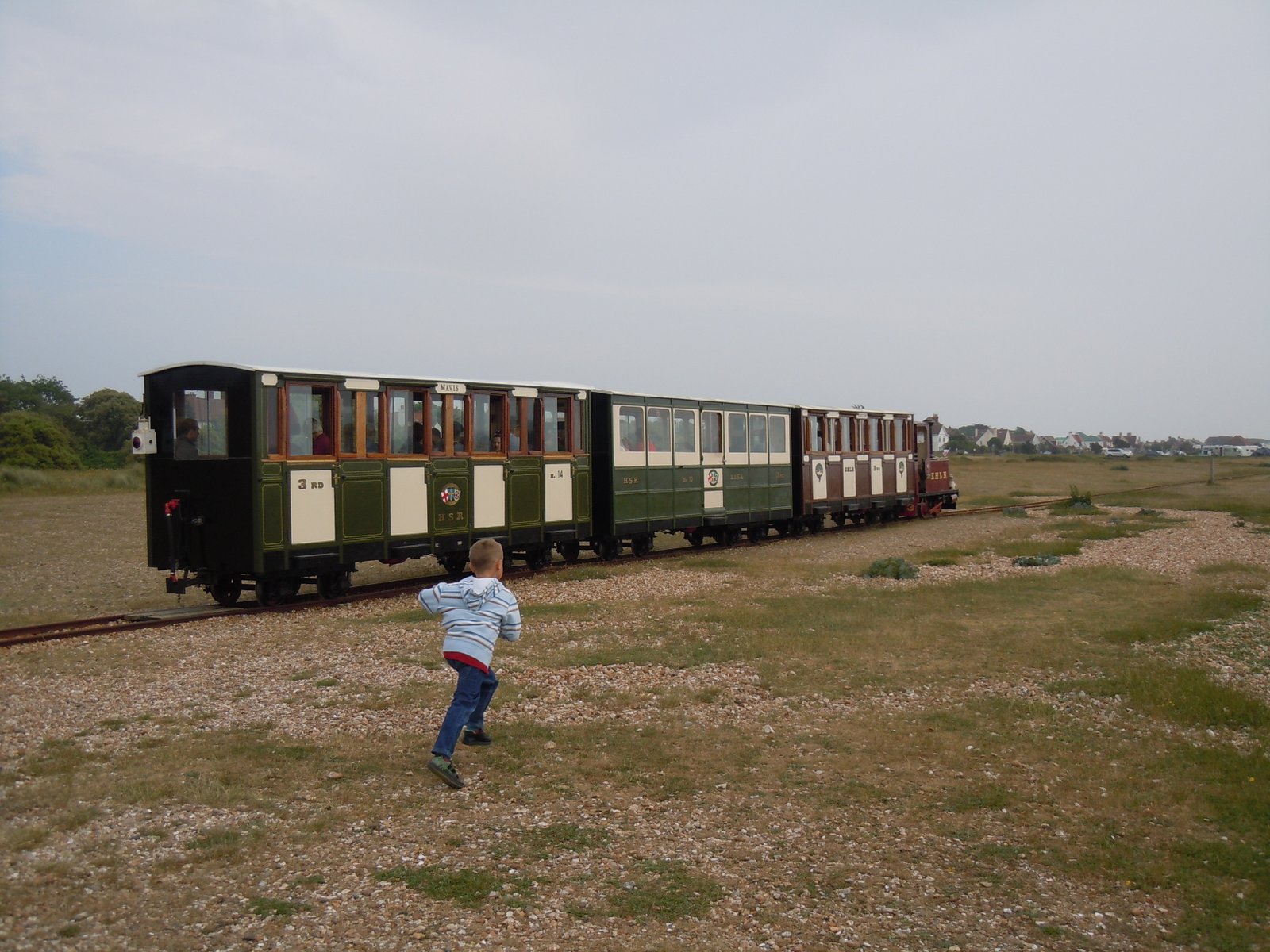
En-route to our holiday recently we stopped off at Hayling Island, to have a ride on the Hayling Seaside Railway. This little 2' gauge pleasure line, which only opened in 2003, starts from behind the Funland funfair at Beachlands. For it's entire route of just over a mile it runs along the back of the shingle beach, with a passing station mid-way (Mengham Road) and a simple terminus at Eastoke Corner.

 
Jack, the main motive power, is an Alan Keef steam-outline diesel hydraulic, which very much looks the part even if it is a "fake". I understand the railway hopes to have a steam loco eventually. (I should point out that this was the "Jubilee" week-end, hence the smoke-box decoration - I presume it does not always run decorated with flags!)

 
At the sheds behind Funland a couple of other diesels are being seen to. Full details of the loco fleet are on the railway's website. The coaches are very nicely finished, built at the company's own "Loston Bodge"(!) works.


The train travels at a leisurely pace along it's largely unfenced route, much to the amusement of my Son who found he could keep up by running!
Posted by Picasa