Sunday, 18 October 2015

A trip to Uckfield

In the peak of the exhibition season is the Uckfield show, one that stands out in my eyes as somewhat above average. And I don't just say that as I took Awngate there last year! The focus is on interesting layouts with good scenics and stock, in a variety of scales and themes, that are inspirational and enjoyable no matter what your particular interests are.


There were so many layouts I liked it was hard to narrow it down to a few favourites. One was Heybridge Wharf by Mike Corp, a 3mm scale (14.2mm gauge) light railway in Suffolk, it packed a lot into a small space and looked superb.


Oldshaw in P4 (Alan Bevan & Maggie Clark) shows that a "modern image" (well, 1980's) theme can have character and operational interest in a compact space. The appearance was just the right level of weathering and subtle tones without looking decrepit and depressing. And while I'm not usually taken with DCC sound the noise of that class 37 shunting reminded me of hearing ICI trains from my Geography lessons.


Obbekaer is a finescale HO (P87) layout by Geraint Hughes is based in Denmark, so a railway system I have no knowledge of. But again here is a simple concept of a passing station, beautifully executed with interesting details. This was my son's favourite, so to have captivated an 8-year old without fast exciting trains says a lot.


Rolvenden (Robin Gay) here modelled in P4 is a prototype that is well known, but not easy to model as convincingly as this. The fine trackwork of P4 really does add to the light-railway character, and the locos and stock recreate the quirky trains of the real line.


Now what scale would you guess this is? I'd be happy with a model of that quality in OO, but this one is 2mm finescale, and as you can see below the layout is tiny - the scenic area is about 2' 3" long - and was built to be carried in airline hand-luggage. On top of that the subject is a real place - or at least a small part of the Kyle of Lochalsh, the lighting and backscene really set the feel of a misty Scottish harbour.


I'd better stop there but really all the layouts were excellent, and there was good trade support too, the only problem being that it was rather crowded on Saturday morning! You can view more photos and more layouts at this link.

Tuesday, 13 October 2015

Taking a ride by model train

On Sunday afternoon we happened across the Worthing and District Society of Model Engineers running an open day for their 5" gauge railway. They hold public running days a couple of Sundays a month from April to October, and have a selection of nicely made and kept locos to give rides around the track.


These little locos are not only superbly detailed models, but surprisingly powerful too. As well as the 5" gauge there are rails for 3.5" and 2.5" gauge models.


The track is raised with carriages that passengers sit astride, and loops around the field twice in a folded figure-of-eight format. Going under the bridge (which is taken at speed ready for the gradient beyond) which has rather limited clearance was rather exciting for someone as tall as me! During our visit four trains were circulating, kept safe by a proper block signalling system with 3-aspect colour lights.


Good to see they have a sense of humour too. If you don't get this, it goes back a few years.


Thursday, 8 October 2015

Awngate at the Croydon Show

So, how did it go? Well, the new fiddle yard did play up on the Saturday. After some confusing symptoms, I think the main issue was just the nut coming loose from the pivot bolt, which is also an electrical connection. It certainly worked fine on the Sunday, and was much easier to use under exhibition running than the cassettes it replaced.


The layout ran well though with little attention. The new locos got plenty of running, and other than some couplings playing up (despite extensive testing some will always misbehave) there were no stock issues.

The show was nice and friendly, with a good selection of layouts. I do like Portchullin by Mark Tatlow, the scenery is superb and it has real atmosphere, despite being a P4 standard gauge diesel DDC with sound layout!


Narrow gauge was well represented, with 5 layouts in total. Puero Pasco in On30 by Giles Barnabe is a little different, being based on an imaginary Caribbean island, making for rather busy operation.


John Thorne's 009 layout Bottle Kiln Lane is always popular at shows, and is packed with little details.


There are more pictures here.

Now with the layout back home and set up in the dining room I've reverted to the compact version of the cassette fiddle yard. I don't operate intensively at home, and my wife had made comments about the larger fiddle yard...

Tuesday, 29 September 2015

A Coach and some wagons

The upcoming exhibition at Croydon this weekend, to which I am taking Awngate, has pushed me to finish some projects that have lingered on the workbench.

A little while back I briefly featured a coach I'd started building. It's a Five79 kit RC810 for a Dundas Tramway coach, nicely moulded and went together very easily - until I got stuck with the couplings. A bar is provided to attach Bemo type couplings to the bogies, but that wouldn't work with the Microtrains couplings I use. I didn't need them attached to the bogies as the couplings pivot, but the wheels are so close to the end of the body mounting the couplings behind the buffer beam would foul them. So the kit sat half-built while I pondered what to do.


As is often the way with these things the solution was simple. I added a "coupling block" to the buffer beam from plasticard, which provided something to mount the coupling on so it didn't foul the bogies. Such "outboard" coupling blocks were not unusual on narrow gauge stock, even the screw protruding slightly gives the impression of a coupling pin.


The coupling mounting arrangement is clear seen from the underside. In front is one of the four bench seats for the interior - a nice moulding that if available separately, could be put to many uses!


After the couplings were sorted it was a simple job to complete the build and paint it, weathered to a slightly grubby state. It could do with lamp tops, and passengers of course - but for now it is serviceable. It's a moderately tall vehicle but not long, and fits well with on the layout - ideal for mixed trains I think, with a few wagons and a goods brake van.


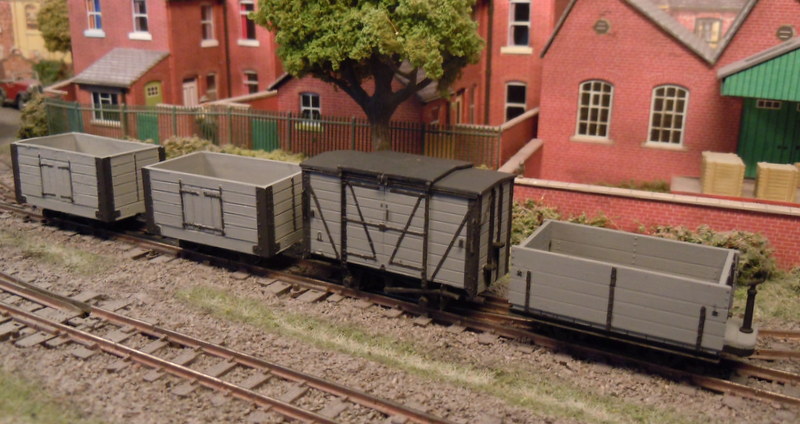
Talking of wagons a few have been knocking around the workbench - another RNAD van and Bagnal open, plus a couple of opens from the second-hand sales stand, they're less detailed but provide variety. I like NG goods trains to have a mix of wagons.


But I don't like wagons to be too clean! A few minutes work with a wash of acrylic "dirt" and a dusting of weathering powders really tones them down, the opens could now do with some loads. I'm working through fitting couplings, and checking/adjusting them on much of the stock ready for the weekend.

Sunday, 27 September 2015

Finishing a pair of locos

It's nearly October, and I've just checked - it was June when I last posted about these locos! They've sat waiting for a few finishing touches, now with an exhibition looming it was time to tie up the loose ends and get them ready.


The Hunslet has been given a working "oily rag" look. This involves washes of acrylic paint over the loco - it seems not to stick to the shiny finish but working it in, and wiping off with a kitchen towel or cotton but eventually gives the right finish. Some subtle use of weathering powder is followed by a coat of Testors Dullcote - after all of which the over-shiny paint finish has just a dull sheen, and the loco has so much more character.


With a crew fitted the motor and flywheel are well hidden, the roof has been attached and couplings fitted. She runs well too I'm pleased to say.


With the Atkinson Walker I've gone for an even dirtier look, for a loco that is less cared for (despite being newer), or that has perhaps been recently acquired from a closed line. The same techniques were used, this time with the acrylic wash being brushed downwards in a rain-streaked fashion. This view shows the rudimentary interior: a representation of the cylinders and a some levers, along with a (leg-less) driver.


The exhibition is the Croydon Model Railway Society show next weekend - if you get there do say hi! I've got some more testing of couplings and stock preparation to do this week, and I'm hoping the new fiddle yard performs well.

Tuesday, 22 September 2015

Attachment

A few more pictures of the new fiddle yard, showing how it's attached to the layout. I'd managed to make it the same width of Awngate (20% by design 80% luck I think), so I was able to use the split-hinge method. These make a very strong and rigid join, provide good alignment, and are quick and easy to join and disconnect.


One hinge is attached to the back of the layout, quite high up, and at the front another was attached lower down - this explains the "pillar" at the front corner. I removed the "wing" from Awngate to fit it - it will be refitted over the top.


The original fiddle yard made electrical contact via wire wipers touching contact pads on the layout, so it made sense to use the same method for the new fiddle yard. I've used strips of brass, though I'm not convinced they are strong enough, but seem to work for now.


Finally a view through the fiddle yard towards the layout, I've allowed plenty of finger space between each track. The front track is aligned, meaning the back of the deck is only just clear of the wall to the right.

Saturday, 19 September 2015

Tracks and Wires

With the structure complete it's time to add track to the fiddle yard, and wire them up. The wiring took some thought, given the deck both slides and rotates - the "usual" solution of sliding bolts to conduct power to the aligned track wouldn't work unless there was one for each rail, and that seemed too fiddly. In the end I settled for micro-switches and wiper contacts...


This view of the sliding deck with the rotating deck removed shows the pivot bolt, two micro-switches protruding through at the sides, and six brass pads. The C-shape slot was for passing cables to the deck, but in the end I found that wasn't necessary. The two micro-switches act as a pair to reverse the polarity to the tracks on the deck, a notch in the underside of the rotating deck means one is "on" and one is "off".


Five micro-switches on the sliding deck act to power the aligned track only, which is fed to the rotating deck via the brass pads to the wiper contacts. These are arranged to that as the deck is rotated the tracks are fed from the correct feed - as the rear track becomes the front one, etc. The middle track is split into two "stubs" (e.g. for railcars), so the wipers also ensure only the correct "end" is live. All tracks share a common feed to one rail, which is fed via the pivot bolt - you can see it mounts though a piece of PCB. Strips of PCB across the deck make connecting the wires easy, as well as keeping the tracks in place.


Further PCB strips at the ends of the deck secure the rails firmly. The end of each rail is given a slight chamfer on the inner edge to help in case of slight mis-alignment. The micro-switch rollers give rough alignment as they drop into the notches, but they aren't strong enough to give precise alignment and there is some slack in the construction (!), so a check by putting a finger on the rails is a good idea! There's enough friction that the deck is unlikely to move while a train is moving.


A wide view of the deck, the handles "up" lock the rotating deck to the sliding deck. The stub track on the right end isn't live, but may prevent derailment in the event of an overshoot... though I'll confess both ends don't always align together!


Slid right forward clear of the wall, and the ends of the fiddle yard, and handles "down" form end-stops to the tracks as well as allowing rotation.

There's a fair bit of wire knitting underneath to make this work, and there has been considerable frustration (including a faulty micro-switch, and a couple of misaligned ones) to get it working - but it does actually work now!