Tuesday, 26 April 2022

Narrow Gauge South 2022 (Part 1)

Last Saturday both Loctern Quay and Slugworth & Co. were at Narrow Gauge South, having been delayed a couple of years! It was good to be back at a large narrow gauge show for the first time since 2019, and see lots of familiar and meet new faces. NGS is always an excellent show, and large with around 25 layouts, although when showing a layout (or two) it is hard to spare time for a good look round. I did take some photos, though being rather rushed many of them didn't come out too well. 


Just before the show opened my son tests his layout, with the sweets ready for the kids (young and older) who can spot all the details. We had many comments on how much bigger/older Joshua looked compared to his photo when building the layout almost 4 years ago! On the left Phil Savage practices operating Loctern Quay - he did get the hang of the shunting puzzle eventually. A big thanks to Phil. Tim Sanderson, and Simon Wilson who helped us out at different times of the day. 


It was nice to see my old layout Awngate being shown by its new owner James Edwards. He has spruced up the scenery in places but otherwise it is unchanged. 


Fellow Sussex Downs group member Martin Collins was showing his fabulous 009 layout Llandecwyn, and using most of the club members to help out. 


I was pleased to see Nic Arthur's new layout, Hazelcombe (009). Nic has a real talent for scenery. I took these photos during set-up and had meant to take some more later...


Nic also has a sense of humour it seems!


The Dovey Valley railway (009) by Dick Wyatt is a true classic from 30 years ago, even featuring in a Two Ronnies sketch. It incorporates a long run of track and two stations in a moderate space, while allowing long trains. 


This was said to be Dovey Valley's last showing and despite its age, it deservedly won best in show. 


The Dovey Valley was an inspiration to me as a young 009 modeller, thanks to featuring in an old Model Railway Constructor annual. 


It was good to see Jamie Warne with his atmospheric Sandy Shores layout (009).


It's such an original imaginative layout, and nicely modelled. 


I liked Woody Green Basin (009) by Phil Russel, which shows what can be done in a compact space with both operational and scenic interest. 


Charles Insley's Ulvaryd (Stand) (009) is based on Swedish narrow gauge, and makes another attractive and unusual layout. 


This attractive scene is Tan-Y-Llyn (009) by Steve Flay. 

Next to Loctern Quay was Garreg Wen (009) by Matthew Kean. It's become a well-known and popular layout thanks to its superbly modelled locos and stock based on Welsh railway prototypes, as well as the Welsh-inspired scenery. 

I'll follow this up with a part 2 covering more layouts... 

Friday, 22 April 2022

Finishing three little wagons

The three little wagons have now been through the paint shop. I find paint covers much better over a primer, even when painting plain plastic, so all got a spray of grey automotive primer. Since they are destined to be used as part of the shunting puzzle on Loctern Quay, they each needed to look distinctive.

I decided to paint the steel open wagon in the "Dutch" yellow and grey livery once used by British Rail for their engineering department wagons. Of course, Loctern Quay is set pre-war long before British Rail, but it's a distinctive livery, and why not? I applied a coat of white, then of yellow onto the sides. When dry, Tamia masking tape was pressed firmly onto the upper part of each side, and another coat of the grey primer spray applied. This worked surprisingly well, and the primer is a good wagon grey colour. 

A piece of foam-core board cut to fit neatly in the wagon had the card face removed on one side, and the foam carved to a mound. Painted black, it was covered in ballast. The wagon was weathered, and had couplings and a little lead sheet fitted underneath. 

Looking for a recognisable load for the flat wagon I found a model cable drum in my bits box, it may be by Knightwing but I am not sure. It was painted, given a cotton thread "cable", and a supporting frame made from plastic strip. I've no idea if this is how a cable drum would be secured, perhaps a rope or two would be needed, but it looks plausible. The wagon got a bauxite brown livery, since most of my wagons are grey. 

The Corris-style van also got the bauxite/brown livery, and like the other wagons a basic weathering treatment of a well-thinned brown wash and a dusting of weathering powder. This had longer (Microtrains 1016) couplings fitted, since I had some (I'm running low on 1015s) and the buffer beams were very deep. 


 Finally of course, a wagon card was made up for each, so they can be used in the shunting puzzle.

So the new wagons are ready for service on Loctern Quay at Narrow Gauge South at Eastleigh tomorrow. Do say hello if you can make it. 

Wednesday, 20 April 2022

Slugworth & Co. in Railway Modeller


My son Joshua's layout features in Railway Modeller (May 2022)!

I'd actually been suggesting he write an article since he won an award in the Dave Brewer challenge at the 2018 EXPO-NG. However, only when the editor Steve Flint got in touch to suggest an article did he decide to - and even then with some help and encouragement! The article tells why he built the layout and the thinking behind its design, as well as how. 

The article points out that Slugworth & Co. will be at Narrow Gauge South exhibition in Eastleigh this Saturday (as will my layout Loctern Quay). Do say hi if you see us. If you are looking for the boy in the photos in the article, it is surprising how much he has grown in the three and a half years since he finished the layout...

Sunday, 17 April 2022

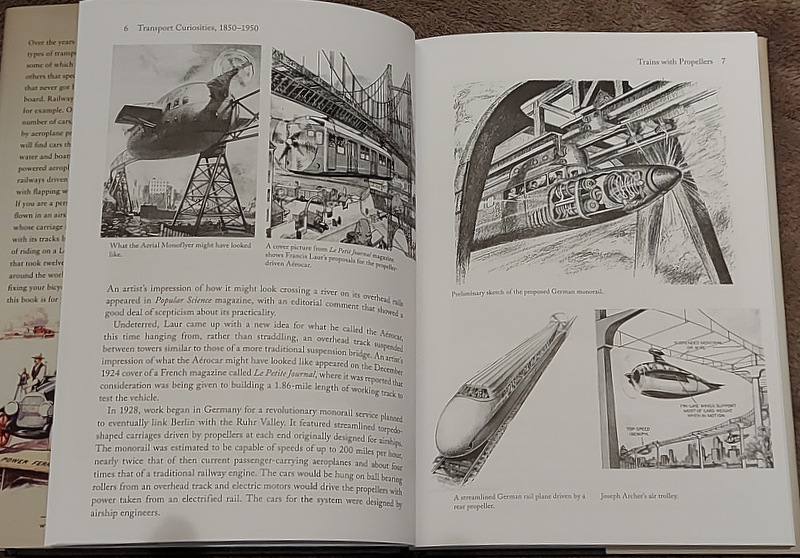
Transport Curiosities

Some inventions changed the world. The steam train, the motor car, and the aeroplane have each revolutionised transport. The monorail, airship, and autogyro didn't catch on in the same way. In Transport Curiosities 1850-1950 John Wade explores some of the curious ideas inventors have promoted for transportation over the century when mankind moved from primitive railways to the jet plane. 


Some of the ideas, such as early submarines and flying machines, developed into practical technologies which we see in use today. However, many leave us wondering, what on earth were their creators thinking? Trains and cars driven by propellers, mono-wheeled vehicles, bicycles with wings? What about a train to the centre of the earth? Of course many of these never got beyond a drawing, but some incredible inventions - including a railway along the sea bed - actually got built. 


The book is packed full of these curious and sometimes crazy inventions, profusely illustrated with contemporary photos or engravings. The text is brief for most, although some get more details, there is just enough to be interesting without getting technical or historical. Some of the chapters show how curious concepts were the forerunners of transportation we have today, but many of the concepts shown were destined to remain dead ends. However, this isn't really a book for those who want to know the development of transport, this is an entertaining review of the imagination of inventors. Whether you have an interest in transport, engineering invention, or just the quirky and unusual, this is indeed a curious gem of a book. 

Saturday, 2 April 2022

Little wagons

I thought it would be nice to have another van for Loctern Quay, so I was looking for a small van that looked different to the others, and preferably had some character. At the Doncaster Show I found a Dundas (ex Rodney Stenning) kit for the Corris Railway brake van. 


Now I don't need a brake van and the Corris van only had a door on one side, but the kit includes parts to have a door on both sides and to replace the windows with ventilators. I also omitted the side buffers and filled the holes, and fitted handles to the door and doorframe but not the corners of the van. 


Unusually the kit has whitemetal underframe sides, which give some useful low-down weight, though I may still add a little lead. I simply stuck them with Bostik, but added strips of plastic behind their ends to ensure they stay in place. The wheels are the new type supplied by Dundas, which having the correct back-to-back spacing and no separate tyres to come loose are an improvement on the previous wheels, but are solid disc rather than spoked. The holes in the floor are to allow solvent fumes to escape after fitting the roof. 


Both the floor and the roof are pieces of plasticard needing cutting to size, although the roof is pre-curved. This does mean a little extra work and care compared to a more modern kit, although the mouldings are clean and the parts fit together well making it a nice kit to build. I added microstrip to the tops of the sides as shown for the roof to glue to, to help prevent the roof being pulled down against the side here. 


I've also built a couple more of the 009 Society kits, another flat wagon and a steel sided wagon. I'll have to think of different/interesting loads for these. 


The little Corris-style van is a good size match for these small wagons. Next, the paint shop.

Thursday, 24 February 2022

River Banks

 When I visited Devon last summer I got some pictures of the river Dart at Hexworthy. 


My model can only include the riverbank, and the very edge of the river, which means capturing the feel of this place will be a challenge. The river banks are a challenge in themselves, consisting mainly of large boulders. 


Some of those boulders are pretty huge - the size of a car - while others are small. While some are rounded, some are quite angular.


A while back (actually nearly a year ago!) I cast boulders in plaster using a Woodland Scenics mould. The castings look great, but are somewhat regular in size and roundness. 


So I made my own boulders from DAS clay. These are not so much sculpted as carved, like chunks of cheese, keeping an angular appearance hopefully reminiscent of the large angular blocks seen in the photos above. The DAS blocks were cut to sit on the riverbanks but give the impression of being embedded in them, but the cast plaster boulders were set into the riverbank by cutting recesses into the scenery. 


As well as the riverbank along the front of the layout, I lined the stream with (slightly smaller) boulders.


Rocks and boulders come in a range of sizes though, so smaller ones are needed. These were added from a pack of Woodland Scenics "Coarse Talus" - I've no idea what that is supposed to be, other than small rocks. 


These were added around the larger rocks, hopefully in a random and natural way. I think the mix of sizes and shapes is quite effective, but of course the colours are not - cream colour clay, grey plaster (I'd added paint to the mix), and brown rock.


Out with the paints then. I started with a grey over the clay and plaster rocks, with a thin wash over the Talus rocks. I then stippled on a dry brush of a pinkish-grey shade, and of a yellow. Actually, the painting process took a few rounds of washes and dry brushing, and finally a dusting of talcum powder over the damp paint. 


The colours are now more unified, but keep some variation, and the Talus and plaster casts keep their texture. I've also mixed up some more tile grout and back-filled the banks up to the back of the boulders to set them in. In due course grass and undergrowth will come right down to and overhanging the boulders. 


The smaller stones in the bed of the river and stream are from another Woodland Scenics bag, of fine Talus. These have also been given a thin wash of grey paint but don't seem to have taken it as well as the larger rocks, though it has toned down and darkened them. 


There may be more I can add to the rocks to represent the lichen and moss seen on them. I now also need to think about how to model the water. My options are:
  • Use a commercial water product - but I've no experience of these, and the river is very shallow with a low lip at the baseboard edge - I'm not sure how well it would be contained
  • Use gloss modge podge as I did for Loctern Quay - while this worked well for a painted "water" surface, any depth would take a lot of coats and I don't know how well it would dry if put on too thick
  • Given the colour of the water in the photos above, good old yacht varnish might be a good bet. I used this on a layout I built in my teens, the main problem was it creeping up the banks which didn't look great. 

Saturday, 19 February 2022

Festival of British Railway Modelling Doncaster

Last weekend I took Loctern Quay all the way to Doncaster for the Festival of British Railway Modelling exhibition. While it was a long trek it was good to be at a big show, and despite its small size the layout attracted a lot of positive comment. Many asked about the buildings, and I could point out the nearby Petite Properties stand!


Here's my friend Tim Sanderson showing how not to operate the layout by standing right in front of it, though to be fair this was a quiet moment and Tim was learning how it works. Tim had brought his own small 009 layout The Old Quarry - we fit the two layouts and three of us in one car


The Old Quarry is an attractive scenic layout with a simple track plan, and some ferociously tight curves!


A big show such as this can host large layouts, but I am always drawn to the small layouts, such as Ladmanlow Sidings, which is modelled on the Cromford & High Peak railway. This shows that a simple layout with simple but effective scenery can ooze atmosphere. 


Leysdown, an EM gauge layout by Adrian Colenut, is another layout that has a simple concept beautifully executed. 


Some of my favourite layouts in the show were in smaller scales. Blueball Summit in N-gauge shows an incredible level of detail for such a small scale, with consistency and effective composition, and well-modelled trains too. 


Sandy Bay was another remarkable N-gauge layout, this time set at the seaside with a harbour and fishing village as a backdrop to the viaduct. This end-view gives a different perspective to the attractive scene. 

Heybridge Wharf makes effective use of the unusual scale of 3mm:ft in a harbour scene, with fine modelling of a sailing barge as well as the buildings, and of course the trains themselves. 

So the long journey was worth it for a good show, it was nice to see and speak to lots of visitors, and good to see Phil Parker and Colin Peake.