Showing posts with label books. Show all posts

Thursday, 12 January 2023

How to build a model railway (the book!)

There have been a lot of books about how to build a model railway over the years, although perhaps less so in recent times. Maybe newcomers to the hobby turn to the internet instead these days, although from the basic questions frequently asked on forums it is clear there is a lot to be said for a reliable source from which to pick up the basics. This book, How to build a model railway by David Ashwood and Market Deeping model railway club, is a first book on model railways by publishers Pen & Sword as well as a first book by the author, and aims to provide an introduction to those basics.


It does indeed provide an introduction to the hobby, covering scales and gauges, planning, baseboards, tracklaying, electrics, and care and maintenance. It will be obvious to modellers that isn't a comprehensive how-to since it omits the scenery and buildings, and indeed the trains themselves, so presumably there is meant to be a part 2 - although the title doesn't acknowledge this. The basics are covered as expected, although sometimes I wondered if terminology and techniques are explained well enough for a complete beginner. Also, in places I thought the subject chosen to include were unusual; there is a description of using computer control through MERG CAN-BUS - this is to give an example of advanced techniques not a how-to, but it is given more space than DCC, which is more likely to be of interest to a newcomer to the hobby. Overall though the book does what it says on the cover, at least so far as the topics listed, and will help newcomers to the hobby get started with the essentials of baseboards and working track. 


One way the book is a little different is how it uses examples to illustrate different approaches and techniques in a practical way, the author drawing on layouts built by the club or club members. This works well, using actual applications rather than a dry description, and brings in different perspectives as well as showing a range of types of layout, scales and genres. Mostly the approaches shown are relatively traditional, which is reasonable given the target audience. In reality, this book is likely to be one of several sources of information for a new modeller, and it is likely to complement the use of magazines and the internet very well. 

Now if the name of Market Deeping MRC rings a bell, it is the club that a few years ago suffered mindless vandalism to its exhibition, with models of the club and its members destroyed. This shocking story hit the news and modellers like myself could only imagine the hurt this must have caused them. The book opens with the author describing how he opened up the school hall to discover the destruction, but also the support and generosity they received from around the world following the news. Out of these metaphorical ashes the club is now working to promote the hobby and open it up to people who may not otherwise have thought of modelling - such as through schools - and this book is a manifestation of that ambition. Now that is an excellent reason for the book, and I really hope it helps bring people into the hobby.

Saturday, 5 November 2022

Mail by Rail

Right from the earliest days of the Liverpool and Manchester railway, the railways played an important role in carrying the mails. In Mail By Rail, Peter Johnson tells the story of two different ways the Post Office used railways to speed up the delivery of mail.


The first part of the book covers the travelling post office (TPO), the trains that didn't just carry mail but sorted it en-route and even collected and deposited sacks of mail while travelling at express speeds. This allowed mail deliveries to be speeded up so letters posted one afternoon could be delivered at the far end of the country the next morning. The TPO became famous through the 1936 promotional film and poem "The Night Mail", the Great Train Robbery of 1963, and the Hornby working TPO coach that added fun to many a train set. The book tells the story from the earliest mail sorting in a converted horse box, the development of the exchange equipment, to the network of TPOs that once covered the country, and to the end of TPOs as services transitioned to simply carrying sorted mail. It even lists the accidents involving TPOs. For the real enthusiast or historian, the TPO services are detailed and carriages listed, including for the many pre-grouping companies which ran TPO services. 


The second part of the book covers a less well known mail railway service, the private narrow gauge underground railway linking sorting centres and railway stations across North London. This was built to get around (or rather under) the London traffic - some things never change! This hidden automated railway known as "Mail Rail" operated for 80 years, carrying mail bags but not people, but now can now be visited and ridden, which is something I must get around to. 


The appendices include more detailed information about the Mail Rail system, including technical details and the rolling stock. I can't see it being an attractive model subject, but I found it fascinating. 

The book has an unusual subject - well, two unusual subjects that are linked - but it is an interesting area of history, since neither TPOs nor Mail Rail are in operation today. No doubt part of the appeal is that their operations were largely hidden from public view, occurring in the dead of night or deep underground, yet they provided a very ordinary public service. 

Sunday, 17 April 2022

Transport Curiosities

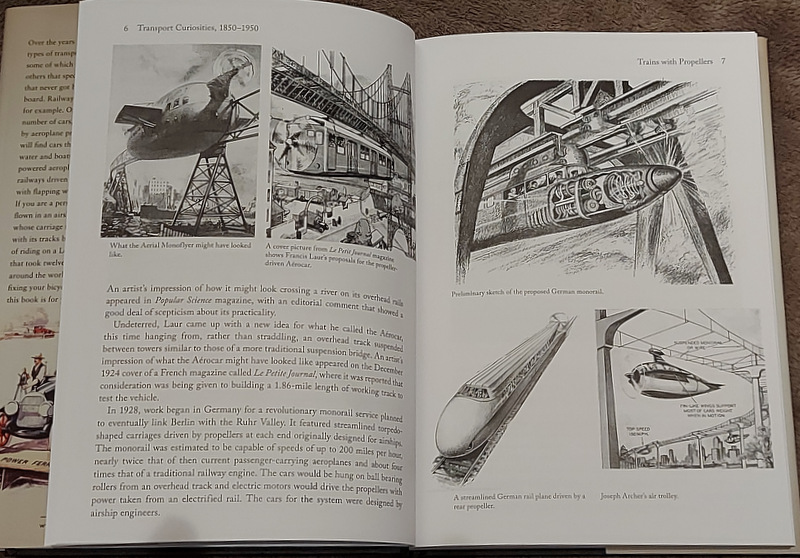
Some inventions changed the world. The steam train, the motor car, and the aeroplane have each revolutionised transport. The monorail, airship, and autogyro didn't catch on in the same way. In Transport Curiosities 1850-1950 John Wade explores some of the curious ideas inventors have promoted for transportation over the century when mankind moved from primitive railways to the jet plane. 


Some of the ideas, such as early submarines and flying machines, developed into practical technologies which we see in use today. However, many leave us wondering, what on earth were their creators thinking? Trains and cars driven by propellers, mono-wheeled vehicles, bicycles with wings? What about a train to the centre of the earth? Of course many of these never got beyond a drawing, but some incredible inventions - including a railway along the sea bed - actually got built. 


The book is packed full of these curious and sometimes crazy inventions, profusely illustrated with contemporary photos or engravings. The text is brief for most, although some get more details, there is just enough to be interesting without getting technical or historical. Some of the chapters show how curious concepts were the forerunners of transportation we have today, but many of the concepts shown were destined to remain dead ends. However, this isn't really a book for those who want to know the development of transport, this is an entertaining review of the imagination of inventors. Whether you have an interest in transport, engineering invention, or just the quirky and unusual, this is indeed a curious gem of a book. 

Monday, 6 December 2021

Book Review - The Snowdon Mountain Railway

The Snowdon Mountain Railway is unique in the UK being a rack railway, climbing steep gradients using a gear on the rack. While it is a well-known 19th century narrow gauge steam railway in the heart of North Wales it is quite different to all the others in purpose, design, and equipment - all the steam locos are Swiss-built and somewhat unusual. As such it is perhaps rather overlooked by enthusiasts. 

Peter Johnson is a prolific author of books about narrow gauge railways including several in North Wales, and in this book he gives the Snowdon railway the same type of detailed history. From its inception and unusual birth (without act of parliament), the opening day disaster (!), the early days of tourism, survival of two wars, through increasing popularity in the late 20th century to being a major tourist attraction, the story is fascinating and at times unexpected. The story also includes the key people involved in the railway and its changes in ownership, its equipment and infrastructure, and operation. 

The hardback book has 260 pages packed with well reproduced photos - mostly period, and some quite dramatic - accompanying the well-written text. There are also maps of the area inside the covers, and reproductions of the maker's drawings of the original locos, carriages, and track. While it may not be a definitive history or a modellers handbook, it does contain everything you would expect of a narrow gauge railway history. 


I've never travelled on this railway despite having holidayed in the area, but having read its fascinating history I do hope to in the future. It may be very different to other narrow gauge railways in the UK, and operates more as a commercial tourist attraction (which it is, and always has been) than a heritage railway, but it does have its own character. This book reveals that character, and does so in an interesting and engaging way. This is a book worthy of a place on an enthusiasts bookshelf, but will also be enjoyed by a wider audience as so many will have experienced the railway and have fond memories, and perhaps as a talking point on a few coffee tables too. 

Saturday, 13 November 2021

Book Review - Narrow Gauge Panorama

Following on from his first book a couple of years ago, roving narrow gauge enthusiast and photographer James Waite has compiled another delightful picture book of narrow gauge railways - Narrow Gauge Panorama - Steaming Along The Rustic And Narrow. 


The formula is just like the first book, packed full of high quality and beautifully composed photos from around the world featuring narrow gauge steam, and each with a detailed and informative caption with brief details of the locos and railways featured. While there are some typical loco portraits, most of the photos show trains in the landscape. The book works its way through 50 countries around the globe covering mainly preserved steam operations, although a few include working industrial railways. The hardback dust-jacketed book of almost 300 pages provides high quality reproduction for the photos on glossy paper. 


So, as with the first book, this is a great addition to the library for those who enjoy steam railways and narrow gauge railways, whether as an attractive coffee-table distraction, inspiration for travellers or model makers, or indeed for the railway interest within. 

Monday, 25 October 2021

Britain's Railways in the First World War

Britain's Railways in the First World War, by Michael Foley, tells the story of how the railways of Britain were both involved in and affected by the Great War. 


The book is very similar to Britain's Railways in the Second World War by the same author, and clearly they make a set. The book tells of the way the railway companies (at that time there were dozens of independent companies) transported troops and materials, turned their workshops over to war work, and suffered staff shortages as so many men were called up or volunteered for service, and so played a vital role in supporting the war effort. The railways also suffered damage from enemy bombing (albeit nothing like as much as in WWII), lack of maintenance, some terrible accidents and loss of locos and stock to overseas, while the railway-owned ships and docks also played an important role. The use of standard and narrow gauge railways supply the troops in the trenches overseas is also touched upon, but not the focus of this book.

As with the WWII book I did find the text jumped around as it attempted to relate topics in a chorological order, meaning there was some repetition as the threads were picked up and dropped, and at times it was confusing to follow. I wonder if breaking the material by topics would have made more sense than by year. On the whole though it is easy to read and does not use technical or difficult language, making it suitable for all readers rather than just railway enthusiasts. 


The book is illustrated throughout which breaks up the text, the photos being printed on normal book paper are not always the sharpest but serve to add interest and some context to the text. Generally this works well, even if some pictures seem to have little relevance, but it would have been nice for them to include the date and location in the caption. Some of the captions add nothing to what is visible in the photo, and even seem to be speculative of the content in some cases. 

Accepting that this is not meant to be a historical textbook, rather more of a story, it does provide an interesting insight into the role of the railways at this difficult time in history. It is a time beyond living memory, and the happenings on the railways then are perhaps less well known than WWII. The book includes the social perspective and summarises political influences as well accounts of operations, giving a broad picture. As with the similar book on WWII, this will be worth a read to those interested in history or the events of WWI as well as those who follow railway history.  

Thursday, 8 July 2021

The East Kent Railway

The sub-title of this book on The East Kent Railway by John Scott-Morgan is The Line That Ran To Nowhere. That might explain why it is one of the lesser known Colonel Stephens lines, even though it possessed the key characteristics that give those railways such character - a eclectic collection of elderly locomotives and carriages, minimal station facilities and track layouts, and short trains with few passengers running through rather empty countryside. Indeed, the cover picture on the jacket of this hardback book beautifully captures that atmosphere.


This begs the question of why the railway was built? Well, the book opens with a short description of the Kent coalfield which was the justification for the railway, yet in the end delivered relatively little. There is then a brief history of the railway, which is sufficient to give a good background and context to the book, and includes a useful map of the surprisingly convoluted route. The line evolved from Shepherdswell to meet the developing coal mines nearby in the run up to the Great War, and during that war had a very light extension to Richborough Port constructed. However, most of the mines had little output (and one never opened), so the area didn't develop, leaving the line with sparse passenger and goods traffic, but enough coal traffic to keep it going until nationalisation, and a section operating to serve the biggest mine until 1961. The book also describes the current preservation project operating that last section of the line today.


It will probably be obvious from the landscape format of the book that the focus is on photographs rather than text though, and indeed the majority of the 200 pages are dedicated to a photo each. This allows for well-sized and consistently good reproduction photos, each with a detailed and informative caption. In this way the story of the line and its locos and stock is provided. This makes a change from the typical book about a minor railway line, and there are no drawings or track plans, while the brief history does not contain details of the railway's construction or operation. However, the format works very well as an introduction to this lesser known line, and inspiration to modellers. 


So, this isn't trying to be a definitive work on the history of this fascinating railway, but rather provide a good overview through well presented and informatively captioned pictures, and it does that very well. It's an easy book to read or just flick through, enjoying the photos and learning about the quaint and minimalist railway that once ran through a quiet corner of Kent. 

Tuesday, 15 June 2021

The Liverpool and Manchester Railway - An Operating History

Having enjoyed the Locomotives of the Liverpool & Manchester Railway book I thought I should read the other book on the line by Anthony Dawson - The Liverpool and Manchester Railway - An Operating History.

As the title suggests this book details how the first public railway worked - organisation, carrying passengers,  goods, timetabling, controlling the trains, and safety matters. These are all activities for which there was no existing model and many of the practices adopted became established as the normal for other railways (and indeed some are today), while others were quickly evolved or changed. The railway was, of course, a success, with facilities such as stations and goods facilities as well as the trains having to be developed to cope with the traffic, especially after other railways were built and connected to the L&M. 

Contrary to my expectation, cotton was not a major traffic (and there were problems with the locos setting light to it!), but coal and livestock as well as general merchandise were, however it was the passenger service that was most profitable. These early passenger services were very much aimed at the higher social classes in keeping the the society of the day, and were split into express (mail and first class) and stopping (second class) services, although fares were too high for working class passengers. 

The original Manchester terminus of the line still exists, now incorporated into the Manchester Museum of Science & Industry. It is a surprisingly simple and unassuming structure but inside had the key features of railway stations until recent times - a booking hall and waiting rooms. Here's a photo from my visit in 2015.

I thought the section on rules and regulations particularly interesting despite the dull sounding title, as it covers how the safety practices developed. Trains were simply dispatched at time intervals with nothing other than a few men with flags or lamps to stop them crashing into each other - of course this wasn't altogether successful (especially given their lack of effective brakes) and accidents are listed. Accidents were also caused by mechanical failure, and indeed by passengers and public on the lines or alighting from moving trains, perhaps not realising the dangers of such large and fast moving vehicles. The rules and regulations developed became the basis of those of other railways although they were soon overtaken by signalling and other safety improvements; and all company employees had to carry a copy on them at all times even though some of them could not read!

As I had expected when reading the book about the locomotives, these two books are complimentary. While that book had little context about the line, this book provides most of that context. As well as the detail of the organisation and operation of the railway there is a map of the line, a number of contemporary engravings showing the railway's facilities, and a few modern photos too; these are contained within a 16-page glossy section of illustrations and are sharply reproduced. 


This is an excellent high quality book with lots detail, well researched and referenced. As you'd expect it's not a light read, I'm sure it will be a useful reference for researches, but it isn't a difficult read either being well written and clearly laid out. There is some assumption of basic railway knowledge around terminology and general operating practice but this is reasonable for the expected audience. It will appeal to anyone who has an interest in the development of the railways in general, as well as those interested in the L&M in particular or seeking to understand local history. 

Friday, 21 May 2021

Britain's Railway Disasters

This book, Britain's Railway Disasters by Michael Foley, is a bit different to others I'd read recently, and not just because I got this one in e-book format for a change. As the title says, it recounts fatal railway accidents from the dawn of public railways to modern times - ending with the Potters Bar accident of 2002. I've no idea if it is comprehensive, but it certainly lists an awful lot, and gives a picture of how rail safety has improved over the years. In the early years there were many incidents of trains running into each other or meeting on the same tracks, as well as mechanical failures, although the numbers of fatalities were often surprisingly low. As trains got faster the accidents were more severe, with wooden coaches telescoping into each other and gas lighting causing fires, so while signalling improvements reduced their frequency the death toll could be far higher. In more modern times safety procedures are much improved and trains are stronger so fatalities are rare, though serious accidents have occurred. 

The book starts with a brief history of the railways in Britain, and an interesting observation on "the effects of rail travel on the person", a controversial topic in the early years of rail travel and shows that medical lawyers are not new. The accidents are then described chronologically. The main source seems to be newspaper reports and so the accounts have the contemporary perspective, and observations on the aspects that newspaper reports sometimes focus on. Reports by the Board of Trade or coroners are also used, but the text often doesn't detail the root causes of accidents or report findings. I guess this depends on what information is available, and avoids repeating the same causes, but there is some commentary on the general trends. 

Personally, I would have appreciated a little more background to the safety systems of the day and how they were failing - a basic description of signalling systems, how they developed, the introduction of braking systems, and other significant legislation could have been covered within the history chapter without being too technical. I think that would have highlighted this narrative to support the fragmented and incomplete story of safety improvement that comes from the descriptions. However, this isn't meant to be a technical book, and there are many other books that look at those aspects of railway safety in detail. 

There are a good number of illustrations, mainly contemporary photographs, although many don't link to the accidents detailed in the text and the reproduction quality wasn't high in my digital edition at least. However, they do show the aftermath of accidents, the destruction of wooden carriages and chaos of derailments, and adds feeling and context to the stories of the accidents. 

This could have been a difficult book to read, but it isn't. The text flows well and the human perspective provided by the contemporary newspaper reports prevents it becoming dry and repetitive. Of course there are some sad stories, but also some miraculous escapes, and the overall theme is improving safety and responsibility from the railways. This is a social history as much as it is a railway history, and tells an important story.

Monday, 26 April 2021

Locomotives of the Liverpool & Manchester Railway

Locomotives of the Liverpool & Manchester Railway by Anthony Dawson covers a fascinating time in railway, engineering, and indeed social history - the development of the steam engine from a primitive and unreliable industrial machine to a means of reliable and convenient transport. The Liverpool & Manchester Railway was of course the first public and passenger carrying steam railway - the railways that existed at that time carried only freight (usually coal or minerals), and very few (including the Stockton & Darlington) used steam locomotives. 


The story of the Rocket winning the Rainhill Trials is famous enough to have featured on a £5 note, and the father and son team behind it George and Robert Stephenson are well known for developing the steam locomotive into a practical reality. This book starts in the run up to the Rainhill trials which were actually about whether steam locomotives should be used at all, rather than to select a winning design. Strangely the book doesn't describe the trials, but continues with the development from Rocket to the engines used when the lined opened (incorporating several significant advances), and then through the early years of the railway as knowledge of steam engines increased with each new design. While the Stephensons had much influence initially, they were resisted by some and alternative designs were tried - generally it must be said with little success, although within a few years it was those running the locomotives in daily use who gained the experience to improve the designs. 


As an engineer I found the development story fascinating - the early locomotives had no effective means of controlling steam into the cylinders, no balance weights to counter the massive forces of moving motion, poor firebox designs and no smokebox, not even any brakes. The engineering ideas had run ahead of materials science, and fireboxes, boiler tubes, and cranked axles failed regularly - as did the track. The early locos had shockingly short lives - 2 to 3 years in some cases - before wearing out or becoming obsolete due to advances in technology. The familiar outline and key features of steam locomotives appeared in those first few years, rather like the development of horseless carriages into motor cars about 60 years later, in fact the advances in technology at that time can be compared to the development of the mobile phone, rise of the internet, or transition from G-Wizz to Tesla in more recent times - arguably with a greater impact on mankind. 

The book goes on to discuss the early enginemen and foremen responsible for operating the locos, their maintenance and repair, and the passenger and goods stock - this is interesting as like the locomotives there was no existing template, and early designs had their flaws. However, there were some strange omissions from the book as in many ways it fails to set the context. There is no background to the Liverpool & Manchester railway - why it came about, the key events in its history, even its geography (which has relevance to the locomotives) - nor the parallel developments in the railway world at that time. As noted above even the Rainhill trails are glossed over. I notice that the same author has written an operating history of the Liverpool and Manchester by the same publisher (which also looks interesting) and perhaps that fills some of these gaps, but properly setting the scene in brief here would help understand the subject of this book better, and could have been done in a short prologue, or even an appendix. 

Also, some of the technological developments were not well explained, such as the advantage of a blast pipe, or how a good firebox and boiler work so as to understand the primitive versions then being developed. One diagram shows Buddicom's valve gear with the comment "from which the Stephenson-Howe link valve gear was an obvious evolution" - except that without an explanation of Stephenson-Howe link valve gear it is not obvious at all. As an engineer and railway enthusiast I generally had little difficulty in understanding the technologies described, but if it wasn't always clear to me it then won't be to all readers. Given the object of the book is to "chart the development" of these locomotives a few extra words or diagrams to explain some of these ideas would help many readers. 


That said, there are some excellent illustrations from contemporary drawings (both technical and illustrative) and engravings - of course there were no photographs at that time, although a few of modern replicas are included. The text is well written and easy to read, and is clearly well researched. I found it a fascinating read, and anyone with an interest in steam engines, engineering, or history of the industrial revolution will enjoy it too. 

Tuesday, 9 March 2021

Book: Britain's Railways in the Second World War

Britain's Railways in the Second World War by Michael Foley is a new book from Pen & Sword. Obviously I've an interest in railways, and as an important part of Britain's recent history I take an interest in the World Wars too, so was intrigued by this book. 


It is what it says on the cover, the story of how the railways of Britain reacted, coped, and were used during the war, from evacuating children to feeding the essential manufacturing to moving troops and armour, all while struggling with reduced staff and limited resources. The story is told chronologically, from the start of war through Dunkirk and the Blitz to the support of D-day and beyond, although these events are the background and have an impact on the railways this isn't a military story. There are many human stories, and much about the organisation and running of the railways. 

The text does sometimes jump from one topic to another, and there are some instances of a topic being repeated from another perspective, maybe this is due to the chronological approach but in some places careful editing and rephrasing could have made the text flow better. Strangely, the GWR was referred to as GWS several times throughout the book (so not an isolated typo), even using GWR and GWS in the same paragraph, this and a couple of other minor errors suggest proofing could have been more rigorous.  Overall though, the text is engaging and interesting to read, and avoids complex and technical language making it easy to follow. 


The book is illustrated with photographs, many of them from the period and some with a direct connection to the text, although for a few the relevance is tenuous and probably better subjects could have been chosen. Reproduction is not great, being printed on the standard paper, and all in black and white although some originals would have been colour. Perhaps they would have been better grouped into photographic paper sections, which would allow better definition and possibly colour, although for those linked to the text this would have been less effective. In any case, this book is a story and historical picture, not a photo album, so the use of the photographs is appropriate in adding interest rather than being key. 

There is also a glossary, although it seemed rather short, readers who are not railway enthusiasts or without some familiarity of British railways might have appreciated a more comprehensive glossary.  A nice touch is the short chapter detailing where some locos, stock, and memorials from the time can be found, and noting that preserved railways can give a feel for what wartime railways may have been like. 


I found this an enjoyable book that feels more like a story than a history book to read. It tells of an important aspect of the wartime struggle and what life was like for the railway companies and their workforce. For those with even a passing interest in railways or in the impact of the second world war this is a book worth reading. 

Saturday, 5 December 2020

An Encyclopaedia of British Bridges.

OK, I like bridges. I guess as an Engineer I like many things structural and mechanical, and I'm always interested in how things work and why they are the way they are. I even did a little Civil Engineering as part of my degree, so have a basic understanding of them, and bridges are such a visual illustration of forces at work. So perhaps not surprising that this book by David McFretrich caught my eye

It's a massive book - large hardback format, almost 450 pages, and rather heavy - and is exactly what it says on the front. It doesn't list every bridge in Britain of course, but aims to list all those of interest; historically, structurally, aesthetically, socially. Many of them (near half) are illustrated with a photo, though of course these are by necessity rather small. Some photos are rather poor, being dark or grainy, which is understandable where it is a historic image but I'm sure better quality pictures could have been sourced in some places. The short text entry gives the background, history, key structural and aesthetic details very succinctly, with references and even listing any walks that pass it.

As well as the encyclopaedia and references, and a geographical index, the book starts with a brief outline of the types of bridge and how they work - very clearly and simply. There is a "miscellany" with further information, categories, and background, referring to listed bridges. It is a good quality book that seems very well put together. The author not only knows his bridges but is enthusiastic about them, yet he is able to explain the subject well - this is not an engineers textbook, it is accessible to any reader. It's probably not a guide for modellers either, though I think it is good inspiration for the many types of bridges in Britain. 


Of course probably this isn't the sort of book you read from cover to cover, but it is a fascinating resource to dip into and flick through. If like me you find bridges interesting, or if you like structures, architecture, or history, you will find this interesting. 

Tuesday, 17 November 2020

British Steam Locomotives - A Pictorial Survey

This new book by David Mather serves the seemingly growing interest in industrial railways. The title tells you what it is - pictures of industrial steam locomotives. Although a portrait style as befits the typical photograph, it is a medium size and relatively hefty 200 pages - most of which contain a photo, and many of those are full-page - in a quality hardback format with dust-jacket.


The biggest and best known industrial steam locomotives builders as well as a number of less well known companies - 39 loco builders in all - are covered in alphabetical order. Each is introduced with a concise history and profile of the company, and where preserved examples can be found, though there are no lists (except numerical output by builder as an appendix) - this is a pictorial survey of course. There were a few examples of poorly-phrased text but the content was enough to be interesting and provide background, while allowing the majority of space to be filled with pictures. 


The pictures range from period black and white, early colour, through early preservation to the present day. I particularly liked the period colour photos, which are handy weathering examples of in-service industrial locos for modellers. Generally they are interesting shots with informative captions about the loco and the location of use, though the date of the photo was not always given. 


I did find some of the photo choices odd, sometimes not showing the loco well. There were 12 pages of Austerity locos - I know they were a numerous class, but it didn't feel very balanced, and there were few narrow gauge - not a single "quarry Hunslet" which is another numerous industrial class. All are of locos in use in the UK except three photos of North British locos in use overseas; since many of the loco builders listed were also prolific exporters this seemed inconsistent, as was the photo of a traction engine! Also while it might be expected that early period photos are of variable quality, I noticed a few of the more recent photos of preserved locos were pixelated, grainy, slightly out of focus or badly framed - surely better photos could have been found? 


If that sounds picky, it is really - overall the book "does what it says on the tin". Those with an interest in industrial steam locos, or even steam locos in general, will enjoy browsing the pictures, and perhaps learning about loco types and builders that are less well known. Modellers will find it a useful resource for details, liveries, and weathering, and perhaps some unusual loco inspiration. I can see it being a good book to while away some lockdown hours, or as a Christmas present, and why not? 

Monday, 14 September 2020

The Welshpool & Llanfair Light Railway

 Another book by prolific NG railway author Peter Johnson has recently been published, this time on the Welshpool & Llanfair Light Railway. 


The hardback book is similar in style to Peter's other recent books on the Vale of Rheidol Railway and the Corris Railway, all three share a common factor - they all came under the ownership of the Great Western Railway, and these books are expanded from some material that was compiled in Peter's book on the Great Western Narrow Gauge Railways a few years ago. 


A substantial portion of the book deals with the various proposals to build a railway to Llanfair, and how the successful scheme came about, including the local and central government funding. The periods under Cambrian and Great Western control are then covered. The nature of a book based on research of documents of a historical time means much of the content comes from official minutes and records, with some operational details and limited personal perspectives. 


There are plenty of photographs which are reproduced well, including some recent photographs, and some covering the preservation era, but most are period photographs. Sections of photographs covering for example locomotives or rolling stock are interspersed between the chapters. A map and gradient profile is included inside the covers, while some period maps are included giving detail of the main station layouts. There are no stock drawings though, which modellers like to see. 


The later part of the book tells the story of preservation to the present day. This is a nice end to the book, but this is a big story in itself which by necessity is covered only briefly. Key events and developments are noted, but by comparison to the original building and early operation of the railway this is clearly a whistle-stop tour. 


So this isn't a "definitive" work on the railway, but it is a good quality book with good photos and detailed but readable and enjoyable text. It tells a story of a rural railway with basic facilities that served its community for around 50 years, then after a difficult transition to preservation, has flourished as a characterful tourist railway. Whether it is a line you know well or not, if you like narrow gauge or minor railways then I am sure you will enjoy this book. 


Monday, 11 May 2020

The Vale of Rheidol Railway

Just as lock-down got under way I got a new book by Peter Johnson - The Vale of Rheidol Railway.


This is an unusual narrow gauge railway, unlike most Welsh lines it's main traffic has always been tourist passengers. Yes it did carry goods and minerals when built, but tourism was the main driver for it's construction, and what kept it going through five different owners - including British Rail, who didn't close it but kept it running into the 1980's. Although it had a limited variety of locos and stock compared to some lines, and perhaps takes less of the limelight, it is an interesting railway in beautiful scenery.


The book is written in Peter's usual chronological story-line style, similar to that used in his recent book on the Corris railway and before that, his books on the Ffestiniog Railway, and the Great Western Narrow Gauge Railways. The latter book did of course cover the Vale of Rheidol since the GWR was one of it's owners, but in this book Peter is able to go much more deeply into the history of the line - which starts with the early proposals, takes us through construction and early years, ownership by the Cambrian, British Railways/Rail, and into private ownership in recent times.


There are many photographs giving a flavour of the line through the ages, including a few in recent years, although the majority are period and therefore black and white.Reproduction is excellent, the book is of good quality and the text is clear and well written. Peter is able to make history interesting and easy to read. Modellers may be disappointed that there are no drawings of locos or stock (though there are some excellent photos). There are some maps but the only track-plans are period documents showing the changes at Aberystwyth, and while there are lots of photos of the trains and scenery there are surprisingly few of the stations or facilities (perhaps unsurprising for a tourist railway).


So like the Corris book this isn't a definitive volume, but it is a complete story of the line to date, an enjoyable read and a good pictorial record of this attractive railway. So a good way to spend some time in lock-down!

Friday, 17 April 2020

British Steam Locomotive Builders

British Steam Locomotive Builders by James W. Lowe, and published by Pen & Sword, is a pretty hefty book. It's about the size of an old family bible, and pretty heavy too, but with 700 pages of fine print it is full of information. It provides an index of British steam locomotive builders from the earliest days of experimental machines, through the Victorian era and into the Grouping, up to the days of British Rail.


Although a new release from Pen & Sword it is actually an old book, originally printed in 1975 as steam locomotive building came to an end - except of course in preservation or tourism, which is excluded. As well as the railway companies themselves, locos were built by many independent companies which are listed - from those that built just one loco and most will never have heard of, to those more familiar names such as Hunslet, North British, and Beyer Peackock, that built many thousands for domestic and oversees use. That of course includes narrow gauge locomotives as well as standard, and even broad gauge, and locos for industrial and minor lines as well as main lines and public railways.


As such the level of detail for each company varies from a few paragraphs, some have tables listing all locos built, for others this would be impossible and their output could fill a book on their own, but main types and developments are listed or described. Railway company works are listed by site. As well as tables, the book is peppered with photos showing a few locomotives built, though of course these are just a tiny sample. The text does document some of the key developments in technology by some of the loco builders, and how they evolved through mergers and acquisition to form new companies. I cannot say how complete it is, no doubt some small loco builders could have been missed, but I would guess it is as complete as any such volume could be.


As a reprint of a 45 year old book and because of it's size, printed on ordinary book paper (i.e. not glossy), the photos are not of high quality. I guess the printers did not go back to the originals. However, this does not detract from the usefulness of the book, which is intended as a reference and interesting study of the loco builders. There is an index which looks potentially useful.


My interest in narrow gauge means I was familiar with a number of loco builders, so I found this very interesting - but was still surprised at the number and variety of loco builders in the "golden age" of steam locomotives. Perhaps it's not light reading and yes it is more of a reference, but if you have an interest in steam locomotives this is well worth having, browsing, and keeping for a spot of research.