Tuesday, 15 June 2021

The Liverpool and Manchester Railway - An Operating History

Having enjoyed the Locomotives of the Liverpool & Manchester Railway book I thought I should read the other book on the line by Anthony Dawson - The Liverpool and Manchester Railway - An Operating History.

As the title suggests this book details how the first public railway worked - organisation, carrying passengers,  goods, timetabling, controlling the trains, and safety matters. These are all activities for which there was no existing model and many of the practices adopted became established as the normal for other railways (and indeed some are today), while others were quickly evolved or changed. The railway was, of course, a success, with facilities such as stations and goods facilities as well as the trains having to be developed to cope with the traffic, especially after other railways were built and connected to the L&M. 

Contrary to my expectation, cotton was not a major traffic (and there were problems with the locos setting light to it!), but coal and livestock as well as general merchandise were, however it was the passenger service that was most profitable. These early passenger services were very much aimed at the higher social classes in keeping the the society of the day, and were split into express (mail and first class) and stopping (second class) services, although fares were too high for working class passengers. 

The original Manchester terminus of the line still exists, now incorporated into the Manchester Museum of Science & Industry. It is a surprisingly simple and unassuming structure but inside had the key features of railway stations until recent times - a booking hall and waiting rooms. Here's a photo from my visit in 2015.

I thought the section on rules and regulations particularly interesting despite the dull sounding title, as it covers how the safety practices developed. Trains were simply dispatched at time intervals with nothing other than a few men with flags or lamps to stop them crashing into each other - of course this wasn't altogether successful (especially given their lack of effective brakes) and accidents are listed. Accidents were also caused by mechanical failure, and indeed by passengers and public on the lines or alighting from moving trains, perhaps not realising the dangers of such large and fast moving vehicles. The rules and regulations developed became the basis of those of other railways although they were soon overtaken by signalling and other safety improvements; and all company employees had to carry a copy on them at all times even though some of them could not read!

As I had expected when reading the book about the locomotives, these two books are complimentary. While that book had little context about the line, this book provides most of that context. As well as the detail of the organisation and operation of the railway there is a map of the line, a number of contemporary engravings showing the railway's facilities, and a few modern photos too; these are contained within a 16-page glossy section of illustrations and are sharply reproduced. 


This is an excellent high quality book with lots detail, well researched and referenced. As you'd expect it's not a light read, I'm sure it will be a useful reference for researches, but it isn't a difficult read either being well written and clearly laid out. There is some assumption of basic railway knowledge around terminology and general operating practice but this is reasonable for the expected audience. It will appeal to anyone who has an interest in the development of the railways in general, as well as those interested in the L&M in particular or seeking to understand local history. 

Friday, 4 June 2021

Coincidence?

I came across Fair Price Models who have a small but interesting range of laser-cut wood building kits. What struck me is this low-relief stables/workshop kit (available in 4mm and 7mm scales)...


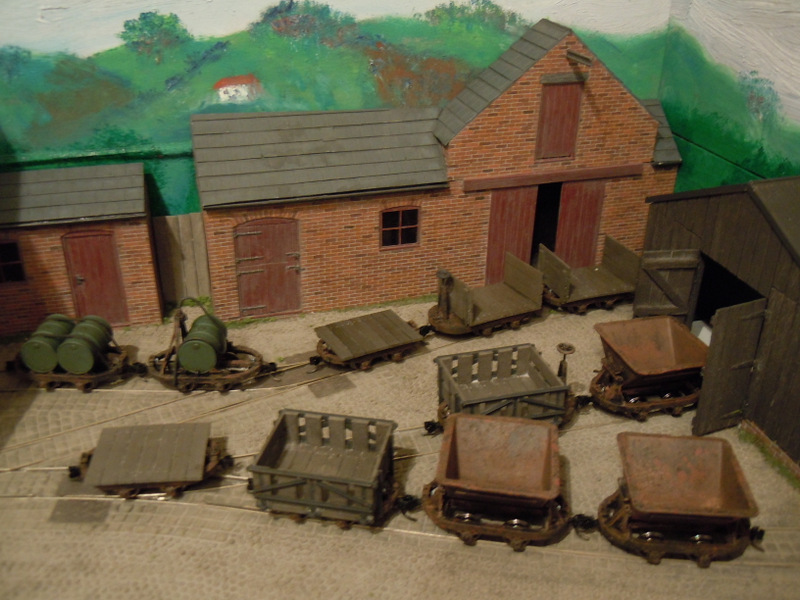
It looks familiar, because back in 2011 I built a remarkably similar building in 7mm scale for my O14  Landswood Park Farm box-file layout:


OK the height of the loft store is different, but otherwise the proportions and details are spot on, even the windows and doors. 

Now that layout was inspired by a visit to Tatton Park Farm, but this building was not based on a prototype but "freelanced" in a similar style to fit the scene, and the outline was evolved during planning. If there is a real building that looks like this I've not seen it, though I wouldn't be surprised as it was meant to look plausible.

So, coincidence or inspired? 

Friday, 28 May 2021

Health and safety

I am very considerate of my 1:76 scale railway employee's safety, and so I have added safety railings to the ground frames. Well, actually I thought it would add a subtle modern twist to the traditional looking station, reflecting the preservation era it is set in. 

At the station throat the 4-lever ground frame has a railing to protect the operator from passing railway vehicles. The railing is 1mm brass rod bent using round-nose pliers and given a waft of primer before being painted health-and-safety yellow, with a little dry-brushed rust and dirt. This was then glued into a couple of holes in the baseboard. 


 At the loco release point by the yard the railings are on the yard side to protect them and the rodding from road vehicles. I'm hoping they offer some real-life protection too, the plastic levers are vulnerable to knocks. With hindsight I should have fitted the levers after completing the scenery...

Friday, 21 May 2021

Britain's Railway Disasters

This book, Britain's Railway Disasters by Michael Foley, is a bit different to others I'd read recently, and not just because I got this one in e-book format for a change. As the title says, it recounts fatal railway accidents from the dawn of public railways to modern times - ending with the Potters Bar accident of 2002. I've no idea if it is comprehensive, but it certainly lists an awful lot, and gives a picture of how rail safety has improved over the years. In the early years there were many incidents of trains running into each other or meeting on the same tracks, as well as mechanical failures, although the numbers of fatalities were often surprisingly low. As trains got faster the accidents were more severe, with wooden coaches telescoping into each other and gas lighting causing fires, so while signalling improvements reduced their frequency the death toll could be far higher. In more modern times safety procedures are much improved and trains are stronger so fatalities are rare, though serious accidents have occurred. 

The book starts with a brief history of the railways in Britain, and an interesting observation on "the effects of rail travel on the person", a controversial topic in the early years of rail travel and shows that medical lawyers are not new. The accidents are then described chronologically. The main source seems to be newspaper reports and so the accounts have the contemporary perspective, and observations on the aspects that newspaper reports sometimes focus on. Reports by the Board of Trade or coroners are also used, but the text often doesn't detail the root causes of accidents or report findings. I guess this depends on what information is available, and avoids repeating the same causes, but there is some commentary on the general trends. 

Personally, I would have appreciated a little more background to the safety systems of the day and how they were failing - a basic description of signalling systems, how they developed, the introduction of braking systems, and other significant legislation could have been covered within the history chapter without being too technical. I think that would have highlighted this narrative to support the fragmented and incomplete story of safety improvement that comes from the descriptions. However, this isn't meant to be a technical book, and there are many other books that look at those aspects of railway safety in detail. 

There are a good number of illustrations, mainly contemporary photographs, although many don't link to the accidents detailed in the text and the reproduction quality wasn't high in my digital edition at least. However, they do show the aftermath of accidents, the destruction of wooden carriages and chaos of derailments, and adds feeling and context to the stories of the accidents. 

This could have been a difficult book to read, but it isn't. The text flows well and the human perspective provided by the contemporary newspaper reports prevents it becoming dry and repetitive. Of course there are some sad stories, but also some miraculous escapes, and the overall theme is improving safety and responsibility from the railways. This is a social history as much as it is a railway history, and tells an important story.

Monday, 26 April 2021

Locomotives of the Liverpool & Manchester Railway

Locomotives of the Liverpool & Manchester Railway by Anthony Dawson covers a fascinating time in railway, engineering, and indeed social history - the development of the steam engine from a primitive and unreliable industrial machine to a means of reliable and convenient transport. The Liverpool & Manchester Railway was of course the first public and passenger carrying steam railway - the railways that existed at that time carried only freight (usually coal or minerals), and very few (including the Stockton & Darlington) used steam locomotives. 


The story of the Rocket winning the Rainhill Trials is famous enough to have featured on a £5 note, and the father and son team behind it George and Robert Stephenson are well known for developing the steam locomotive into a practical reality. This book starts in the run up to the Rainhill trials which were actually about whether steam locomotives should be used at all, rather than to select a winning design. Strangely the book doesn't describe the trials, but continues with the development from Rocket to the engines used when the lined opened (incorporating several significant advances), and then through the early years of the railway as knowledge of steam engines increased with each new design. While the Stephensons had much influence initially, they were resisted by some and alternative designs were tried - generally it must be said with little success, although within a few years it was those running the locomotives in daily use who gained the experience to improve the designs. 


As an engineer I found the development story fascinating - the early locomotives had no effective means of controlling steam into the cylinders, no balance weights to counter the massive forces of moving motion, poor firebox designs and no smokebox, not even any brakes. The engineering ideas had run ahead of materials science, and fireboxes, boiler tubes, and cranked axles failed regularly - as did the track. The early locos had shockingly short lives - 2 to 3 years in some cases - before wearing out or becoming obsolete due to advances in technology. The familiar outline and key features of steam locomotives appeared in those first few years, rather like the development of horseless carriages into motor cars about 60 years later, in fact the advances in technology at that time can be compared to the development of the mobile phone, rise of the internet, or transition from G-Wizz to Tesla in more recent times - arguably with a greater impact on mankind. 

The book goes on to discuss the early enginemen and foremen responsible for operating the locos, their maintenance and repair, and the passenger and goods stock - this is interesting as like the locomotives there was no existing template, and early designs had their flaws. However, there were some strange omissions from the book as in many ways it fails to set the context. There is no background to the Liverpool & Manchester railway - why it came about, the key events in its history, even its geography (which has relevance to the locomotives) - nor the parallel developments in the railway world at that time. As noted above even the Rainhill trails are glossed over. I notice that the same author has written an operating history of the Liverpool and Manchester by the same publisher (which also looks interesting) and perhaps that fills some of these gaps, but properly setting the scene in brief here would help understand the subject of this book better, and could have been done in a short prologue, or even an appendix. 

Also, some of the technological developments were not well explained, such as the advantage of a blast pipe, or how a good firebox and boiler work so as to understand the primitive versions then being developed. One diagram shows Buddicom's valve gear with the comment "from which the Stephenson-Howe link valve gear was an obvious evolution" - except that without an explanation of Stephenson-Howe link valve gear it is not obvious at all. As an engineer and railway enthusiast I generally had little difficulty in understanding the technologies described, but if it wasn't always clear to me it then won't be to all readers. Given the object of the book is to "chart the development" of these locomotives a few extra words or diagrams to explain some of these ideas would help many readers. 


That said, there are some excellent illustrations from contemporary drawings (both technical and illustrative) and engravings - of course there were no photographs at that time, although a few of modern replicas are included. The text is well written and easy to read, and is clearly well researched. I found it a fascinating read, and anyone with an interest in steam engines, engineering, or history of the industrial revolution will enjoy it too. 

Tuesday, 20 April 2021

Turning sand into gravel

Obviously the sand surface needs to be painted if it is to look like anything other than sand. These are large areas, and the sand has a large surface area as well as being abrasive. I use cheap acrylic paints and a cheap, stiff paintbrush - the stuff sold for kids is fine for this job. Colours are mixed from white, black, red, green, and yellow - I can't say I find mixing colours easy and I usually end up with something too dark. Also a single colour sometimes looks too flat and plain, the aim is for a finish that is not too even which I attempt with multiple washes. 

The platform got a coat of pale grey, this seems to have come out well and looks fine as well tended gravel so I left it at that. The road and car park behind got a darker coat which looked too even, so it was followed by a much thinner coat of mid brown to weather it and add shadows. However, this looked too dark, so another thinned coat of pale grey was added. The result is a mid grey that isn't too even as the thinner coats have had differing effects at different depths. 


The yard at the front had a browner shade of grey to represent a gravel, followed by a very thin mid brown wash to add depth. Again, this ended up looking too dark, so I experimented. I dabbed talcum powder over the surface with a sponge, and then vacuumed it off while working it with a stiff paintbrush. The result has worked surprisingly well, giving a pale dusty gravel look which is patchy and varied in colour. 


While the paints were out the mid brown was further diluted with added Isopropyl Alcohol (IPA) - giving a very runny wash. This was applied over all the track ballast, though perhaps more in some areas than others, which adds a slightly brown weathered look to the granite and because it collects in the gaps, adds some depth to the colour. 


So there are three areas with three different finishes from the same basic materials - sand and paint. The front yard is dusty gravel, the platforms a neat even gravel, and the rear roadway and yard a rough tarmac. I've tried to blend them to the surrounding areas such as the public road and the ballast. 

Right at the top of the station access road near the phone box the last coat of paint covered some talc overspill, which has accidentally given a very pleasing mottled look, I might use that technique on purpose in the future. 


I'd also used a little sand to make pathways across and alongside the ballast, which were given similar paint treatment to represent a grey gravel. The walkways aren't really necessary, but gravel is easier to walk on than ballast and probably cheaper too, while I'm also using it to disguise the uncoupling magnet!


Monday, 19 April 2021

Bases and surfacing

The yard at Hexworthy will be used as a "permanent way" (track) maintenance yard, and will have a grounded shipping container. These are often placed on timbers, so I made up some from plasticard, along with a rudimentary ramp up to the doors, and stuck them down before surfacing the yard.


I also added bases for a phone box - which I thought would add interest and look plausible placed by the road entrance - and the heating oil tank. These were simply made from a little DAS clay. 


At the back of the station building I added a pavement from a layer of thick card, cut to the shape of the building by drawing around it. I was going to just run the tarmac up to the back of the building but this seems neater as it means the building doesn't have to be fixed down (yet), it is a tight fit in, and allows easier access to the narrow space behind. It is made simply to represent concrete, mainly as it won't really be seen so no point in putting in a lot of effort!


All the roadways, platform and yard areas are textured with fine sand. I use play sand as sold for children's play pits, having kept a couple of jars when my kids grew out of theirs, though a large bag is very cheap. It is fine enough to be a good representation of gravel or tarmac. First I put down an even layer of PVA glue, which is slightly diluted (about 3:1 with water), and no need for washing up liquid here. 


I use an old tea strainer which helps scatter the sand evenly and stops any oversize particles. Sand is added a little at a time by tapping a teaspoon onto the strainer. This gives an even finish, but I have found it best to let it dry fully and vacuum off excess before checking, and not be tempted to add more glue/sand as this gives an uneven finish. If necessary a second application can be made later, although this is rarely needed. 


I've used the sand for the yard at the front, the platform surfaces away from the paved area, and the road/yard at the rear. Although they look the same now, they will be given different finishes in painting.