Sunday, 27 March 2016

Thakeham comes out to play

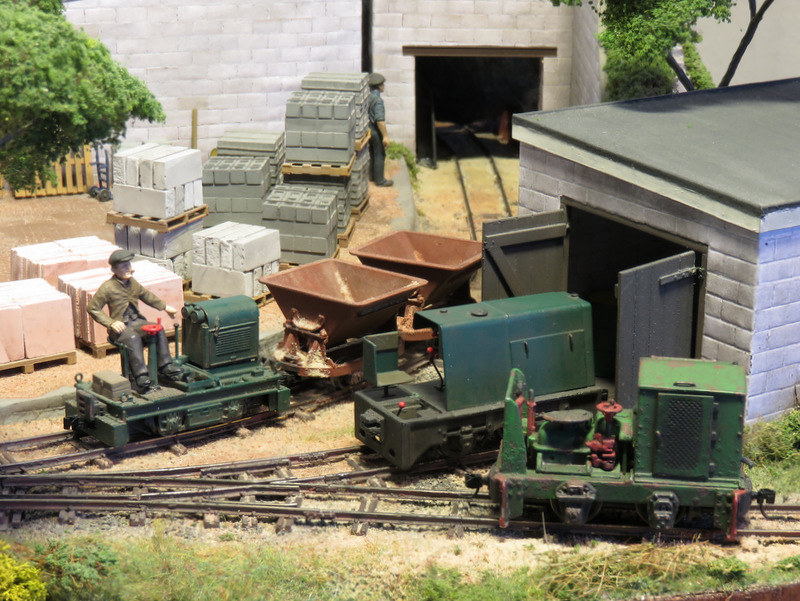
Thakeham will be at the Wealden Railway Group exhibition next Saturday 2nd April, in Steyning. So I've retrieved it from the loft and removed it's cover to check it out. A bit of dusting and a vacuum was in order - some sawdust from fitting the cover mostly - and in some places the printed paper block-work has bubbled, but it's minimal and not normally noticeable.

IMG_0282

I've applied a fresh rubbing of graphite to the rails and test run, which revealed a mystery short circuit when the points were thrown. After some investigation it was found to be a point blade that had shifted along to touch the frog rail - this is a problem as the blade is electrically connected to the stock rail and the frog is switched. Forcing a blade into the gap shifted it back, I'm still thinking of a more permanent solution.

IMG_0295

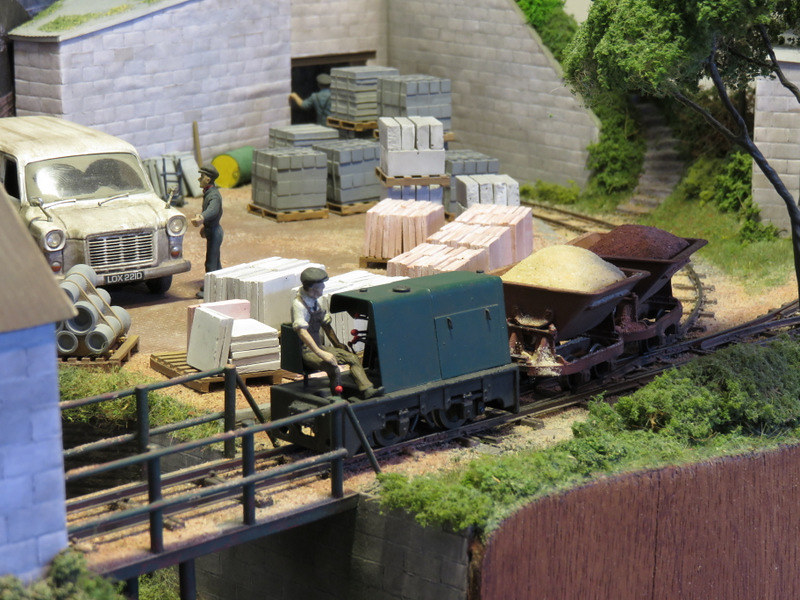
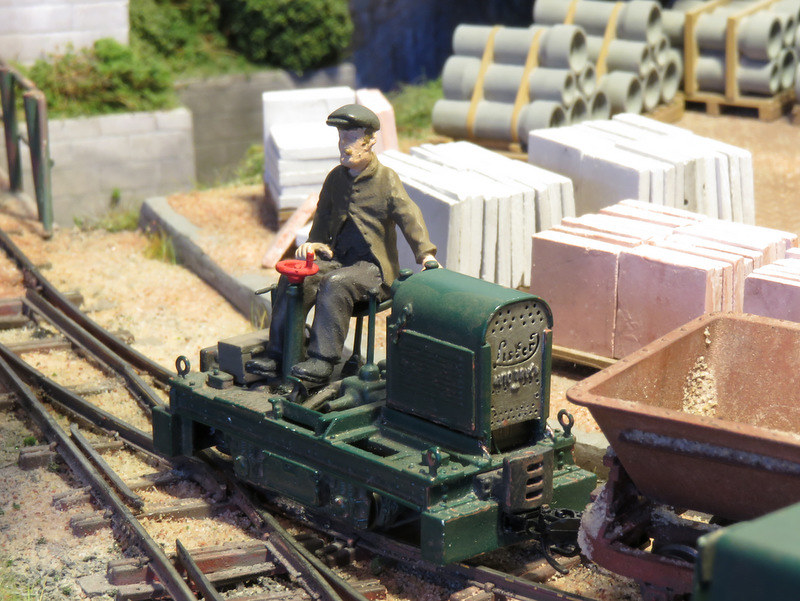
That aside running was smooth and problem free. I will need the super-glue to a couple of details that have fallen off though. However while it was out I took the opportunity to take some photos on my new camera, using a tripod and playing with the manual settings. I'm rather pleased with how they have come out.

IMG_0300

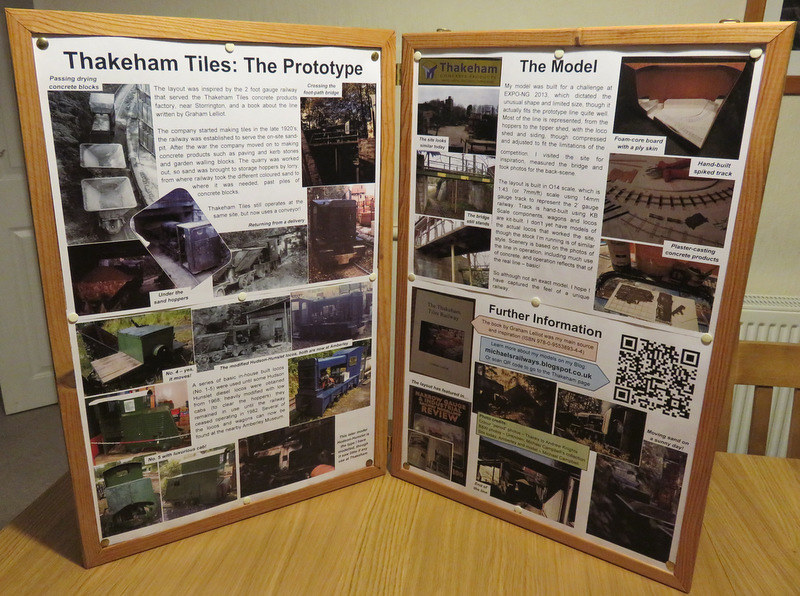
I've been asked to provide some information about the prototype and the model, and exhibition organiser Andrew Knights shared some photos he'd taken of the railway shortly before it closed, so I put together a display using them along with photos I'd taken of the locos now at Amberley, the site today, and the model under construction. The board is simply two cork-boards attached with a pair of small hinges I'd put together some time ago for something my wife was involved in - I knew it would come in useful again!

IMG_0056

If you get along to the show do say Hi...

Saturday, 19 March 2016

Using Map Data

Recently a work discussion about getting map data - in that case the altitudes for a route - resulted in a colleague pointing me at this website:
https://www.daftlogic.com/sandbox-google-maps-find-altitude.htm
It didn't take me ling to think of non-work uses too. As a teenager I doodled many track plans, and often schemed out "might-have-been" railways on Ordnance Survey maps. I'd attempt to check contour lines crossed against distance to ensure they weren't implausibly steep, but it wasn't reliable and as I was often planning Narrow Gauge lines through hilly landscapes the gradients would have been pretty severe.

So I plotted one of my favourite schemes using the website, clicking points onto the map, the "Terrain" view gives contours which help. The string of co-ordinates produced can be copied from the box below the map which I pasted into a text file, then imported into Excel. Plotting the latitude and longitude and placing a map picture behind the plot is a quick way of drawing the route - the Excel plot can be stretched either way so I made sure the two end points were correctly positioned on the map, the rest will then be correct. Click the images to enlarge them.


That's rather fun but the data allows much more analysis - easy enough in excel, even if it is rather like the day-job! This site gives the formula for distance between co-ordinates, so of course gradient can be determined (change in height over distance). However for that I used an adjusted altitude - representing the track height after civil engineering - and calculated the deviation of that from the ground, i.e. the magnitude of the earth-works. The gradient can often be eased by increasing the height of embankments and cuttings, but for a Narrow Gauge line the balance would be in favour of less costly earth moving and more gradient. It's worth bearing in mind that a delta of a couple of meters can be regarded as negligible, and since my route is often running along the side of a slope, it only represents a few meters deviation of route - or of inaccuracy of my mouse-click on the map! I did go back and adjust some points to get a better route.

So here's my analysis. This line does have severe gradients - 1 in 44 for a sustained period, with another at 1 in 37 at it's worst - but these are not unusual for NG lines (the Welshpool and Llanfair has a section at 1 in 29) and are a good excuse for short trains! That does mean the earthworks are minimal, though an embankment or viaduct up to 25 ft (8m) tall is required to cross a valley just beyond Scorriton, and a 25 ft (8m) deep cutting is needed at Holne - both are plausible for this kind of line. A bridge across the West Dart is also needed near the end of the line, but at a point were that would be relatively easy.


This plot shows the altitude of the line (black) with the terrain (green), and also the gradient as a percentage (so 1% = 1 in 100, 3% = 1 in 33).


So I have a plausible route for an imaginary line, and I'll tell you about it's history another time!
Thursday, 25 February 2016

Solent Sky

With a house full of kids in a bleak February half-term the Solent Sky museum in Southampton seemed a good destination. Although a large building it is dominated by the Sandringham flying boat - a massive aeroplane for it's day, it was built in WWII to hunt submarines, then rebuilt to carry 44 passengers.


Rather than just look from a distance it is possible to go inside and explore, which gives a real feel for what flying in the aircraft would have been like. The accommodation is split into compartments with a 1930's style, resembling trains of the time - and more spacious than you might imagine. There is even access to the cockpit - which is more WWII bomber than airliner of course! Taking off from or landing on water in one of these must have been quite something.


The story of the Spitfire is also featured, including the Supermarine racers that spawned it, as well as the many other aircraft companies that were based around Southampton. And for more hands-on action how about sitting in the cockpit of a jet fighter? Here's my daughter giving it a go!


So well worth a visit, I'd say.


Wednesday, 10 February 2016

A New Camera

I had a minor disaster over Christmas. My camera slipped out of my hand while I was sitting on the sofa - but it hit a lamp stand with it's lens on the way down, and that was the end of that. Grrrr...

So I went camera shopping, though the January sales were disappointing there were some offers. While a DSLR or bridge camera would be better for model photography I need a versatile compact camera to serve as the family/holiday camera too, and a limited budget, but there are some good compacts these days with many features previously only found on more expensive models. In the end I chose a Canon Powershot SX710 HS; the 30x zoom lens (yes, really) will be nice when out-and-about but the manual control options are useful for photographing models. Not that I know how to use them!


Of course I had to have a practice, and here is the new camera pointed at Awngate. I don't often use a tripod, but to get some good shots of the layout it's very helpful. As well as the layout lights I've set up a florescent lamp; good light is really important for photography but using the flash really doesn't work well here. I mean it when I say I don't understand all the settings, but I've picked up a basic understanding, so here I've played around with exposure times around a second, and a low ISO number for image quality, while adjusting the manual focus, and letting the camera do the rest.


And here are some of the results. I'm rather pleased with them, particularly the depth of field (that is, the range which appears in focus), which is always tricky with model photography.


However, don't get high expectations for the pictures on this blog, a new camera does not a professional make, and anyway the Auto mode works very well too!

Wednesday, 27 January 2016

Plastic and Nickel Silver

Once I'd done the prep like modifying the coupling pockets the rest of the Hudswell Clarke kit came together quickly. Assembling the cab is a little fiddly, but otherwise it is straightforward. However I did struggle with the roof; the kit has tabs on the top of the cab front and rear that fit half-etched slots under the roof, but I found the slots further apart than the cab was long and the slots too shallow for the tabs. In the end I filed the tabs off altogether, and resorted to another method of aligning the roof - soldering small tabs of phosphor-bronze (it was the thinnest metal I had) to sit inside each edge. For now the roof is loose for painting but they should help to glue it in place when the time comes.


The kit is well detailed as supplied so there's not much to add (I've left brake pipes off for painting, and mine is vacuum braked so I've not fitted the air brake pump). I did notice it was missing handrails so fitted some to the cab, through drilled holes in the floor (would have been much easier if I did that before fitting the cab!) and glued the tops to the inside of the cab sides. I guess I could fit a smoke-box hand-rail too?


I was left with a few small gaps - at the cab edges, the holes for the fuel rails (I didn't use) on the tank top, and the etched grooves under the cab roof. Nothing a spot of filler couldn't resolve. The final task was to do something with the American style cylinders of the Minitrains chassis - photos of Hudswell Clarke locos had European style smooth (lagged) cylinders. In the end I cut a strip of 10-thou plastic to fit between the flanges and secured it to the valve chest side and around the cylinder. I'll see how this looks with a spot of primer on, it may need a little filler too.


Other than cleaning up, and perhaps metal blackening, it is ready for primer. That will wait for warmer weather though. However I do like the look of the loco, chunky and elegant. One thing needs looking at though - it runs with a whine, I think the flywheel is rubbing on the cab front...

Wednesday, 20 January 2016

A Narrow Hudswell Clarke

Back at EXPO-NG I picked up the new Narrow Planet Hudswell Clarke kit, and thinking it would be a quick and easy build, I made a start. It's in their usual style of a 3D printed core with etched nickel-silver overlays to get a good quality surface. However Christmas preparations and family distractions soon got in the way and it was only a week or so back that I actually made any progress.


The first step is to cut down the chassis and replace the outside frames with those in the kit. At first this appeared to introduce a bind to the running, though I could not see a reason. A bit of re-fitting and it has gone, I think drooping pistons were to blame and the con-rods catching the fly-cranks, I've fitted a piece of plasticard over the cylinders allowing the plastic screw to hold them level better.

Next the boiler and side tanks were stuffed with lead - I use sheet roofing lead offcuts which meant cutting into little strips and feeding in from the cab end with tweezers. The "liquid" (balls) variety might have been easier to pack in but isn't as dense as real lead, so overall I've probably achieved the same weight - it's adequately balanced the motor at least. I even cut a piece to fill that void under the front footplate.


I had to open out the coupling pockets to fit Microtrains couplings, requiring an evening with small files and an abrasive bit in the mini-drill, going carefully to avoid damage to the print - especially where the rear pocket is used to locate the body to the chassis. So after several evenings work with little visible progress it was good to be able to start sticking body panels on! At this point I had to make decisions - the kit is rather like a "Vari-kit" with two styles of cab, and two shapes of side-tank, as well as other details. I chose the enclosed cab (more suited to the UK) with straight tanks and without tank-top fuel rails (for wood or cane).


The Nickel-Silver cab etches can be glued but are recommended to be soldered for strength, yet that frightens me as there is a risk of melting the printed core. I soldered the right-side to the front off the model, holding the parts together with magnets, then fitting them before soldering the left-side on. The cab rear and buffer-beam have been soldered together, after the photo was taken they were superglued to the buffer-beam and when that is solid I'll solder the top corners together. A line of flux along the join with some tiny pieces of solder on it, dabbed with a quick touch of the iron, seems to be the safest way to go.

Wednesday, 30 December 2015

Christmas is a time for receiving...

Well Christmas is much more than that of course, but I did receive several excellent gifts of relevance to this blog!


I had an airbrush as a teenager but after a couple of cans of propellant I gave up. Having read George Dent's book (which I was given for my birthday) I thought it time I tried again. This time having been given a compressor and a more suitable airbrush I feel better equipped - looking forward to giving it a try! I also got some Vallejo paints to use with it.


My first Peco R-T-R product, one of their lovely coaches. I'll admit it isn't really at home at Awngate though!


Other gifts included a couple of RNAD wagon kits, a Knightwing kit for an Atkinson steam lorry, and a guillotine cutter - which should be useful for plasticard.

Christmas has included much time spent with family around the country, but so far no modelling. I hope you enjoyed yours, and wish you a happy new year!