Thursday, 25 February 2016

Solent Sky

With a house full of kids in a bleak February half-term the Solent Sky museum in Southampton seemed a good destination. Although a large building it is dominated by the Sandringham flying boat - a massive aeroplane for it's day, it was built in WWII to hunt submarines, then rebuilt to carry 44 passengers.


Rather than just look from a distance it is possible to go inside and explore, which gives a real feel for what flying in the aircraft would have been like. The accommodation is split into compartments with a 1930's style, resembling trains of the time - and more spacious than you might imagine. There is even access to the cockpit - which is more WWII bomber than airliner of course! Taking off from or landing on water in one of these must have been quite something.


The story of the Spitfire is also featured, including the Supermarine racers that spawned it, as well as the many other aircraft companies that were based around Southampton. And for more hands-on action how about sitting in the cockpit of a jet fighter? Here's my daughter giving it a go!


So well worth a visit, I'd say.


Wednesday, 10 February 2016

A New Camera

I had a minor disaster over Christmas. My camera slipped out of my hand while I was sitting on the sofa - but it hit a lamp stand with it's lens on the way down, and that was the end of that. Grrrr...

So I went camera shopping, though the January sales were disappointing there were some offers. While a DSLR or bridge camera would be better for model photography I need a versatile compact camera to serve as the family/holiday camera too, and a limited budget, but there are some good compacts these days with many features previously only found on more expensive models. In the end I chose a Canon Powershot SX710 HS; the 30x zoom lens (yes, really) will be nice when out-and-about but the manual control options are useful for photographing models. Not that I know how to use them!


Of course I had to have a practice, and here is the new camera pointed at Awngate. I don't often use a tripod, but to get some good shots of the layout it's very helpful. As well as the layout lights I've set up a florescent lamp; good light is really important for photography but using the flash really doesn't work well here. I mean it when I say I don't understand all the settings, but I've picked up a basic understanding, so here I've played around with exposure times around a second, and a low ISO number for image quality, while adjusting the manual focus, and letting the camera do the rest.


And here are some of the results. I'm rather pleased with them, particularly the depth of field (that is, the range which appears in focus), which is always tricky with model photography.


However, don't get high expectations for the pictures on this blog, a new camera does not a professional make, and anyway the Auto mode works very well too!

Wednesday, 27 January 2016

Plastic and Nickel Silver

Once I'd done the prep like modifying the coupling pockets the rest of the Hudswell Clarke kit came together quickly. Assembling the cab is a little fiddly, but otherwise it is straightforward. However I did struggle with the roof; the kit has tabs on the top of the cab front and rear that fit half-etched slots under the roof, but I found the slots further apart than the cab was long and the slots too shallow for the tabs. In the end I filed the tabs off altogether, and resorted to another method of aligning the roof - soldering small tabs of phosphor-bronze (it was the thinnest metal I had) to sit inside each edge. For now the roof is loose for painting but they should help to glue it in place when the time comes.


The kit is well detailed as supplied so there's not much to add (I've left brake pipes off for painting, and mine is vacuum braked so I've not fitted the air brake pump). I did notice it was missing handrails so fitted some to the cab, through drilled holes in the floor (would have been much easier if I did that before fitting the cab!) and glued the tops to the inside of the cab sides. I guess I could fit a smoke-box hand-rail too?


I was left with a few small gaps - at the cab edges, the holes for the fuel rails (I didn't use) on the tank top, and the etched grooves under the cab roof. Nothing a spot of filler couldn't resolve. The final task was to do something with the American style cylinders of the Minitrains chassis - photos of Hudswell Clarke locos had European style smooth (lagged) cylinders. In the end I cut a strip of 10-thou plastic to fit between the flanges and secured it to the valve chest side and around the cylinder. I'll see how this looks with a spot of primer on, it may need a little filler too.


Other than cleaning up, and perhaps metal blackening, it is ready for primer. That will wait for warmer weather though. However I do like the look of the loco, chunky and elegant. One thing needs looking at though - it runs with a whine, I think the flywheel is rubbing on the cab front...

Wednesday, 20 January 2016

A Narrow Hudswell Clarke

Back at EXPO-NG I picked up the new Narrow Planet Hudswell Clarke kit, and thinking it would be a quick and easy build, I made a start. It's in their usual style of a 3D printed core with etched nickel-silver overlays to get a good quality surface. However Christmas preparations and family distractions soon got in the way and it was only a week or so back that I actually made any progress.


The first step is to cut down the chassis and replace the outside frames with those in the kit. At first this appeared to introduce a bind to the running, though I could not see a reason. A bit of re-fitting and it has gone, I think drooping pistons were to blame and the con-rods catching the fly-cranks, I've fitted a piece of plasticard over the cylinders allowing the plastic screw to hold them level better.

Next the boiler and side tanks were stuffed with lead - I use sheet roofing lead offcuts which meant cutting into little strips and feeding in from the cab end with tweezers. The "liquid" (balls) variety might have been easier to pack in but isn't as dense as real lead, so overall I've probably achieved the same weight - it's adequately balanced the motor at least. I even cut a piece to fill that void under the front footplate.


I had to open out the coupling pockets to fit Microtrains couplings, requiring an evening with small files and an abrasive bit in the mini-drill, going carefully to avoid damage to the print - especially where the rear pocket is used to locate the body to the chassis. So after several evenings work with little visible progress it was good to be able to start sticking body panels on! At this point I had to make decisions - the kit is rather like a "Vari-kit" with two styles of cab, and two shapes of side-tank, as well as other details. I chose the enclosed cab (more suited to the UK) with straight tanks and without tank-top fuel rails (for wood or cane).


The Nickel-Silver cab etches can be glued but are recommended to be soldered for strength, yet that frightens me as there is a risk of melting the printed core. I soldered the right-side to the front off the model, holding the parts together with magnets, then fitting them before soldering the left-side on. The cab rear and buffer-beam have been soldered together, after the photo was taken they were superglued to the buffer-beam and when that is solid I'll solder the top corners together. A line of flux along the join with some tiny pieces of solder on it, dabbed with a quick touch of the iron, seems to be the safest way to go.

Wednesday, 30 December 2015

Christmas is a time for receiving...

Well Christmas is much more than that of course, but I did receive several excellent gifts of relevance to this blog!


I had an airbrush as a teenager but after a couple of cans of propellant I gave up. Having read George Dent's book (which I was given for my birthday) I thought it time I tried again. This time having been given a compressor and a more suitable airbrush I feel better equipped - looking forward to giving it a try! I also got some Vallejo paints to use with it.


My first Peco R-T-R product, one of their lovely coaches. I'll admit it isn't really at home at Awngate though!


Other gifts included a couple of RNAD wagon kits, a Knightwing kit for an Atkinson steam lorry, and a guillotine cutter - which should be useful for plasticard.

Christmas has included much time spent with family around the country, but so far no modelling. I hope you enjoyed yours, and wish you a happy new year!

Monday, 21 December 2015

The Night Mail

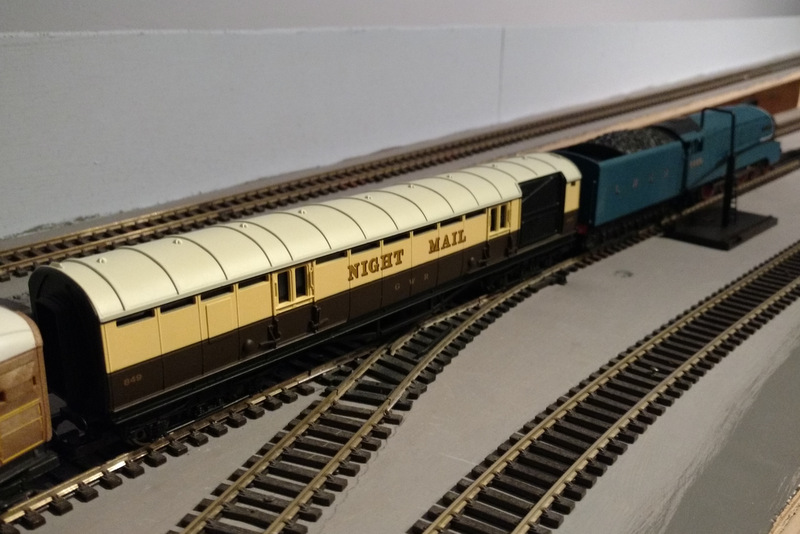
Recently it was my Son's Birthday. He's been asking for the Mallard for some time, so despite being surprisingly tricky to find right now (it had to be blue, apparently) we managed to get him one. While ordering I discovered Hornby still do the Night Mail coach. Now when I was a kid I remember playing with one at a friends, thinking it was so cool, but never got one myself - so I had to get my son one!


This is based on the mail coaches that used to run along the main-lines, picking up mail, sorting it, and dropping it off all without stopping, speeding through the night. That sounds exciting, but the reason I'd thought it so cool was that it operates; it is supplied with some small red mail-bags, a track-side hook and reception bin. Ramps fixed in the track actuate levers under the coach causing it to grab the mail-bad from the hook with a plastic "net", and drop it in the reception bin with another plastic "net".


Well as I can't show that with photos, for the first time on this blog, let's try a video:


All great fun - and yes my Son likes it too! 

Not much actual modelling to report recently - the run up to Christmas always seems so hectic. So Happy Christmas, and back to modelling in the new year! 

Friday, 20 November 2015

Last Train to Evaleight

Expo-NG was billed as the last showing of the Upsands Downs & Evaleight Railway, so it was appropriate to run a last train along the complete line. Thus towards the end of the show an unusual consist was formed at Upsands Harbour, with 8 coaches it was double the length of a regular train. It was both double-headed and banked by three Hunslet 2-6-0 tanks rather similar (but very slightly smaller) than those on the Tralee & Dingle Railway.


Shortly after leaving Upsands the train comes to Gryndene Halt.


The lead loco proudly carries a suitable commemorative headboard courtesy of Narrow Planet.


At Wharf Cut (if you are thinking that station name is missing an awful pun, the W has fallen off the sign) the special train passes a quarry train returning from the brickworks, presumably for the last time. Of course the train is too long for the loop, so other trains had to be diverted to the fiddle yard to clear the line.


The viaduct is usually a good place to photo a train, but this one doesn't fit in shot.


After the final tunnel the special train passes the brickworks, where the battered diesel shunter is parked up. Here we just get a glimpse of the banker loco just exiting the tunnel, but the strain of three mechanisms started to trip the controller so the banker was decoupled here.


Crossing the level crossing on the curve into Evaleight, the railway PW depot is in the foreground.


Entering the station, with the goods yard to the left.


The "last" train actually managed a few trips up and down the line by the end of the show.

So what now for Evaleight? Well there are no immediate plans, but a new smaller and more easily transported layout is being planned. Meanwhile the smaller modules (Evaleight and Upsands) may still get exhibited individually, subject to sufficient estate cars being available, and there is a proposal to rebuilt parts of the layout to allow a smaller version to emerge - so not all of it will get sold or broken up.