Tuesday, 22 May 2012

A Titanic Paint Job

Slow progress has been made recently preparing the Titanic for launch. The model is pretty much finished, as you can see. In this photo the lower part of the hull had been sprayed with Halfords red primer and then masked using "normal" masking tape from the same source.


There was then a pause while I sourced black and white spray paint, B&Q do small cans of enamel but they were out of matt white. So in the end I brush-painted the white, which proved very fiddly and tedious, and required 2-3 coats. In the meantime I had found some Tamiya masking tape (from the Squires stand at Bognor last week), so used this for the white along the top of the hull.
 
The result after a couple of coats of black is shown above, as the masking tape is peeled off the lower hull. The white-black border is crisp and clean, however there is some slight intrusion of the black over the red. Not really enough to worry me, but clearly the Tamiya tape is better, and with hindsight I should have stripped the masking from the lower hull and re-done it with the Tamiya tape!

Now on with the rest of the painting, which looks to be even more fiddly and tedious...
Posted by Picasa

Sunday, 20 May 2012

Narrow Gauge in Bognor

Yesterday was the "SWING" Show organised by the South Downs 7mm Narrow Gauge Association. It's a nice little show with a good selection of narrow gauge and industrial layouts.


"The Loop" by Giles Favell is a 7mm scale layout depicting the interchange of a slate-carrying NG line with the standard gauge. Although the scenic area is just 4' by 2' it packs a surprising amount of operation and detail, and the scenic work is superb.


Khan by Julian Evison, is an 009 layout set in what is now Nambia, south-west Africa. Based on a might-have been development of a real line it depicts a steep climb up a mountain range, which makes for a distinctive and original model, that is fun and serious at the same time.


Halfway by Ken Jackson features both 0-16.5 and 09 (on the higher level) in a small space.

I could go on - there were lots more excellent layouts and live steam in the garden too - but I've posted pictures of more layouts here. I very enjoyable show, with good trade support too.

Sunday, 13 May 2012

A family day out in Burgess Hill

On Saturday I visited the Burgess Hill exhibition, for a change with both kids and the wife in tow. I don't think I've ever visited this show before, but there were some good layouts so it was worth a trip over the hills. In fact there were around a dozen layouts, and narrow gauge was for once well represented, in fact a good range of scales and themes were on show. Here are some pictures of my favourites.

 
Pagham Harbour by Richard Glover (009) was an inspirational layout for me when I started in 009, showing how much atmosphere and realism could be created modelling a fictional scenario in a small space. Richard later rebuilt the layout - slightly larger but keeping the same atmosphere - and it was good to see it close up. Well, I say close up but despite being a mere 6 feet or so long, it seemed to have a big crowd in front of it!


Andrew Knights of the Wealden Railway Group is a prolific small-layout builder (no really, he's built more small layouts than me!), and was showing Sonne, See und Schmalspur, a German sea-side scene in H0e. A fine example of a fun layout that shows what can be built at home.

 
Whiteoak Light Railway (0-16.5) by Martin Coombs depicts a freelance industrial narrow gauge railway, but rather than the usual rural idyllic scene the layout is framed entirely by grimy industrial brick buildings. In fact there is no back-scene, the buildings just continue up until their tops are hidden by the upper pelmet, a cunning ploy that enhances the hemmed in industrial feel. As well as the fine buildings it features a superb model ship, and hosts a selection of unusual industrial locos - mainly diesels made from kits and conversions of Bachmann US outline models.


So just a handful of the layouts - it was a good show, and even the wife and kids enjoyed it. Perhaps more on that another time!
Posted by Picasa

Sunday, 29 April 2012

I've got a sinking feeling...

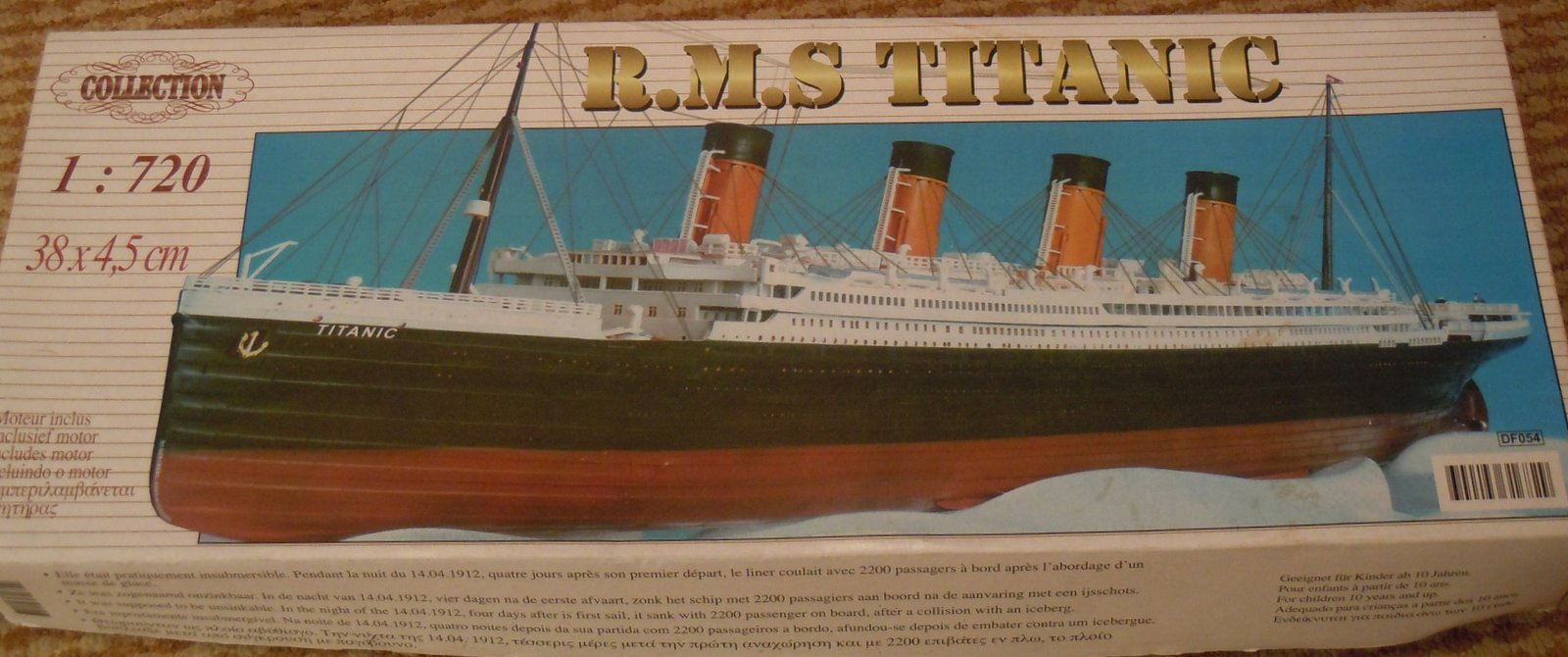
Yes, sorry about the title, but I have been asked to put together a model of the Titanic. It's a bit different from the usual models I make, but it's a plastic kit so the methods of construction are quite familiar. The story of the Titanic is fascinating as well as tragic, and there has been a lot about it recently - this being the 100th anniversary of its maiden and final voyage.

 
The kit consists of a hull, a bag of motorising parts, and three sprues of moulded parts ranging from the decks to the tiniest of ventilators. To be honest I was surprised at the number of small parts, particularly given the small scale of this model - a person would stand 2.5mm tall. Looking at it another way this model is around 15 inches long, if modelled to my usual model railway scale of "00" (1:76) it would be almost 12 feet (3.6m) long, longer than a full-length express train. That really gives me an idea of the scale of the size of the Titanic, and how it would have been seen in 1912. No wonder they thought it unsinkable.


As you can see I have made good progress with the superstructure although there are a number of parts left to fit. The exploded diagram at the top of the instructions shows how many small parts are in each step, there is another page of those diagrams on the other side! However the next step is to tackle that small bag of bits in front - fitting the motor!
Posted by Picasa

Wednesday, 25 April 2012

The Engine Shed Completed

I didn't publish any pictures of the completed engine shed on the layout before Sparsholt, mainly as I didn't have time,  so here are a few. As you can see from a normal viewing position it blocks the exit nicely, and with a Glyn Valley Tramway loco filling the doorway you can see how it ended up this size! Not very clear at this angle, but there is a brick wall around the right-hand side of the shed to hold back the ground.

Pleasingly the details are just about visible through the open doors, provided I don't actually park a loco in there of course! I only used two of the figures from the Wills pack, just enough to add some life without over-crowding the scene. After all it's a loco repair shed of a small railway, not a factory. The card floor has just the right texture for cement, and the inspection pit looks OK, even though it is only a scale 18" deep. The building was bedded into the layout with my usual plaster/sand/powder paint mix which works well here for compacted ash, plus some scatter along the walls.

With the roof removed the detail can be seen better, although the workbench against the near wall can't! The drive shaft was fitted to the building and the lathe, pillar drill, and motor to the floor, so the drive bands had to be made and fitted (from brown evelope paper) after the building was stuck in place, a rather fiddly job.

Posted by Picasa

Wednesday, 18 April 2012

A Model Castle

This may not be the usual type of model featured on this blog, but a little girl turns three tomorrow and needed a suitable cake! A Princess Castle seemed to fit the bill. Most of the work is down to my wife, but my model-making experience gets called upon to help with the final decoration. The figures (Peppa Pig in case you were wondering) came from her toy-box, but the rest is edible!


Posted by Picasa

Monday, 16 April 2012

Exhibiting at Narrow Gauge South


Here's a photo of Awngate set up at Narrow Gauge South. The set-up is reasonably straightforward: assemble two trestles and beams between them, place layout on top and push in fiddle yard, attach leads and power up! There are advantages to such a simple layout, not least being packed up and driving off just 25 minutes after the show ended...

Anyway the day went well, everything worked as it should apart from some reluctant couplings and the new magnets being rather too powerful it seems! Anyway, more on that another time. Many thanks to Simon Wilson for assisting - operation gets tedious after an hour or so, so it is good to alternate, and we both had time to see the rest of the show too in between "shifts". And what an excellent show it was.


Right opposite us was a complete contrast in terms of size and subject, even though it is also 009 Bron Hebog is a model of Beddgellert on the WHR as it is today. Even incomplete it was impressive, and when it is finished to full depth (three times it's current scenic depth) it will achieve the "Railway in the landscape" look. The stock is also prototypical and expertly modelled by Rob Waller - see more on his blog here.


It was also good to see Isle Ornsay by Tom Dauben, even at this early stage of construction it is clear to see it will be a superb layout when finished. I have been following progress so far on Tom's website and the NGRM forum, and he is building the layout to a very high standard. In particular his portrayal of coastal rocks and stone sea-walls from plaster casting promises to be very realistic. Tom has researched the proposed narrow gauge line accross the Isle of Skye and built up a false "history" of the line assuming it was in fact built. It was this that earned him a Certificate of Merit award at the show.


Ryedown Lane, by Pat Collins, is a super little layout I have been following on the NGRM forum. It is based on Colonel Stevens practice, and Pat has got the style of the structures and the atmosphere spot-on. The layout is a similar size to Awngate, but has a spacious rural feel so feels quite different.


I'd seen Castle Wharf Kendal (by Ian Kirkwood) in the 009 News, and really admired it's character, so it was nice to see it for real. It was surprisingly compact, something many people say of Awngate, but like Awngate the urban surroundings help frame the railway giving justification for the cramped layout.


Nettlecombe by John and Jane Jacobs is famous for it's superb buildings and scenery, so no apologies for there being no trains in this picture! It was the first time I had seen the layout but was amazed by not just the lovely buildings and detail, but the extent of the scene. Not just a handful of cottages, but a whole village...


St Braydon by the Rutherford Appleton Laboratories MRC was a huge and impressive 7mm scale layout based in Cornwall. The buildings and scenery were beautifully modelled and instantly recognisable as Cornwall, the detail was nicely observed, and the operation and stock interesting, yet it had a sense of fun too and I'm sure it is popular with kids and families.

I could go on, as there were many more excellent layouts, but this post is long enough as it is so I'll leave you with those appetisers, and point you on to the rest of the photos here.